Relationship axis · Position 1 of 4
Authority relationship in Creative Direction
The expert-to-learner relationship position in the creative direction framework. The brand sets the floor; the reader stands on it.
Authority is the brand telling the reader what is true, having earned the right to do it.
What Authority is
Authority is the relationship position where the brand is the expert and the reader is here to learn. The voice declares. Hierarchy is implicit. The page treats the reader's time as worth respecting and the brand's expertise as worth deploying. Where Peer treats the reader as a co-thinker and Companion walks with them, Authority sits at the front of the room. The reader is being addressed by the entity that has done the work, and the page is the proof.
The position requires actual expertise. A brand at this position needs to demonstrate the work behind the claim: notable matters in legal, capability demos in AI, technical reports in cybersecurity, citations in skincare, exploded views in audio. The Authority register is permission earned through specifics, not through tone. A confident voice without the substance behind it reads as cosplay; the position punishes the gap.
When Authority fits
Authority fits brands in categories where the buyer is making a decision they cannot reverse cheaply. Legal counsel for a transaction, a luxury real estate purchase, a security engagement, an enterprise AI integration, a fine-dining tasting menu. The buyer wants the entity with the strongest body of work, and the brand's job is to demonstrate that body of work without softening it.
The position also fits institutional brands whose audience is partly other experts in the field. Reference documentation for engineers, technical reports for researchers, architectural press for architects. The audience is calibrating the brand against the standard of the field, and a hedged voice signals the brand is uncertain about its own work. Authority is the floor.
What Authority rejects
Authority is not condescending. The position rejects talking down to the reader. The expert-to-learner relationship is not a hierarchy of intelligence; it is a hierarchy of expertise on this specific topic. The reader is treated as capable; the brand is treated as the one with the relevant work behind it. Lecturing register is the failure mode that the position has to guard against.
The position also rejects the trick of claiming Authority through tone alone. A brand that adopts the cadence and vocabulary of authority without the substance underneath reads worse than a brand at Peer or Companion at the same substance level. The position is high-cost; the cost is paid through demonstrated work, not through stylistic mimicry.
Examples in the showcase
12 archetypes that demonstrate Authority
Authority anchors brands across the showcase that have invested in the body of work that makes the position legible. The archetypes below cover legal, real estate, premium audio, AI, fine dining, cybersecurity, and the institutional documentation poles.

Estate
Luxury real estateEstate is the curator of properties at the price tier. Single-image hero, principal letter, quiet typography. Authority is what allows the brand to stay out of the way while the listings do the selling.
See the archetype
Counsel
Business law firmCounsel is the firm hired for its judgment. Practice areas as memos, partner profiles leading with notable matters and publications. Authority is the discipline that lets the firm signal it has the work without staging it.
See the archetype
Pass
Fine dining groupPass is the kitchen with a point of view. Big plate photography, dish stories that read as field notes, reservations as a secondary path. Authority here is the chef's-perspective Conversational variant.
See the archetype
Vector
Offensive securityVector is operator-to-operator. Technical writing that does not soften, redacted client logo strip rather than trust-badge wall. Authority is the operator-grade variant where the buyer is themselves a security professional.
See the archetype
Frontier
AI research labFrontier is publishing a result. Capability demos, technical report, equal-weight safety section. Authority is what permits the launch to feel like a position rather than a marketing announcement.
See the archetype
Anode
Premium electric vehiclesAnode is declarative, manifesto-adjacent, no qualifiers. The premium EV brand treats engineering as art on the page. Authority is the relationship that lets the manifesto land instead of reading as overreach.
See the archetype
Resonance
Premium audio hardwareResonance is audiophile-literate. Exploded views, materials notes, third-person about the products. Authority is the move that signals the brand has the technical substance the category rewards.
See the archetype
Prospect
Home decor and craft objectsProspect is the museum-gift-shop register. Maker provenance, numbered editions, third-person. Authority is what differentiates from the lifestyle-brand register that competitors default to.
See the archetype
Observatory Reference
Reference is the canonical Authority anchor inside the framework. Bloomberg-grade institutional documentation, citations, footnotes. The reader is here for facts and the page is the proof.
See the archetype
Observatory Cinema
Cinema is treated by an authoritative curator. Atmospheric, narrative, restrained UI. Authority is what lets the page operate at A24 / MUBI register without the chrome competing with the work.
See the archetype
Observatory Press
Press is the editorial publication register. Heavy display typography, asymmetric layouts, drop caps. Authority is what permits the magazine voice to land without reading as marketing.
See the archetype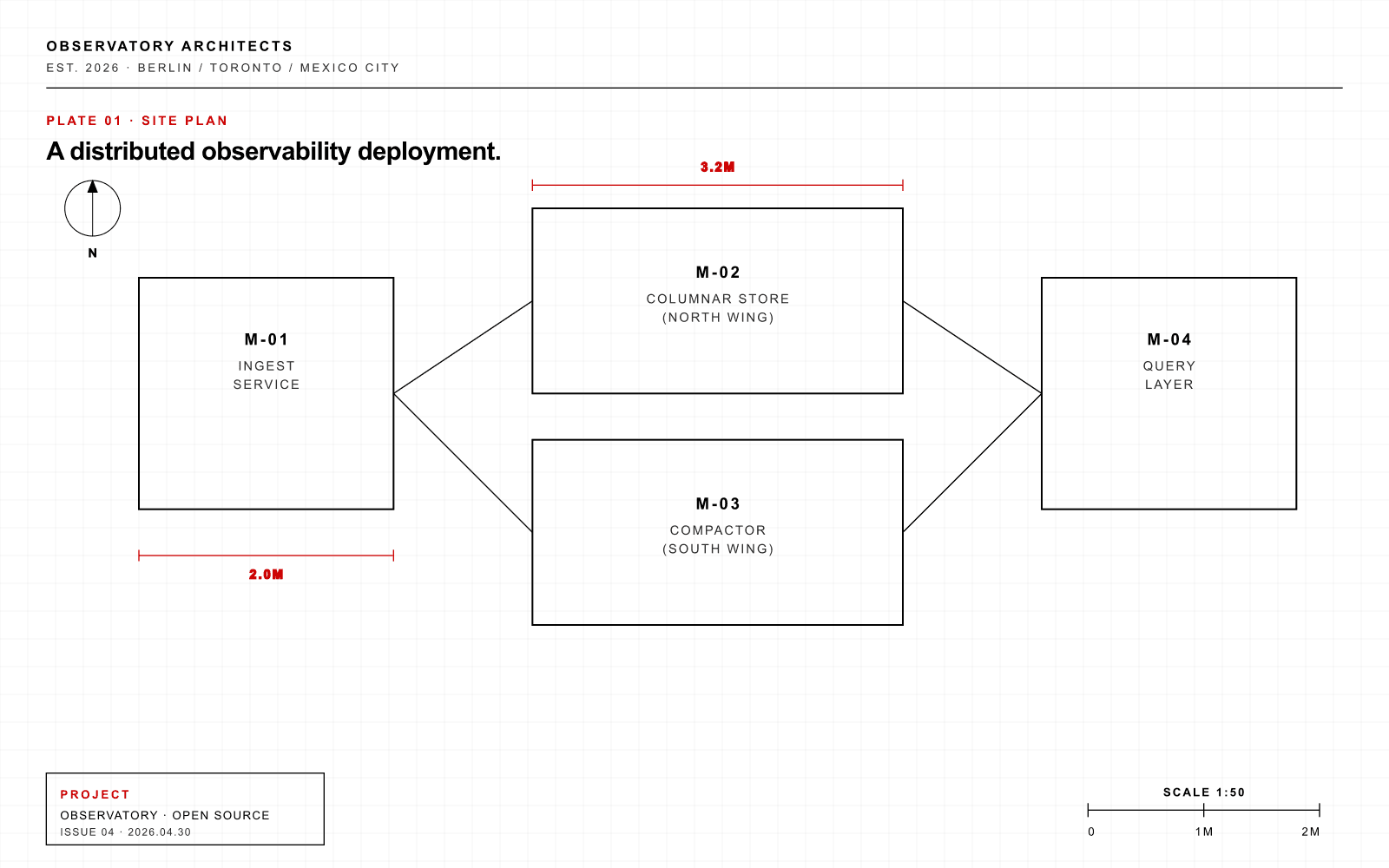
Observatory Plan
Plan is the architectural plate-numbered register. Axonometric drawings, dimensional callouts. Authority is austere; the drawings do the work and the voice gets out of the way.
See the archetype
How Authority composes with the other axes
Authority pairs most often with Editorial Restrained on the aesthetic axis (Estate, Counsel, Reference, Plan, Cinema, Anode). The combination is the institutional / prestige register. With Expressive Maximalist (Vector, Frontier, Press) the position carries through high-energy categories that still require operator-grade signal.
On the tone axis, Authority sits comfortably with Professional (Estate, Counsel, Reference, Plan, Resonance, Prospect), with Conversational at the chef's-perspective variant (Pass), and with Provocative at the manifesto variant (Vector, Frontier, Anode, Cinema, Press). Authority with Playful is rarer and produces work like Workshop's adjacent variant.
Failure patterns
How Authority fails
Concrete patterns to watch for when adopting the position. These are the failure modes the position has to guard against, in order of how often they appear in the wild.
Failure pattern 1
Condescending instead of authoritative
The most common failure is treating the expert-to-learner relationship as a power gradient rather than a relevance gradient. The reader is intelligent; the brand is the one with the topic-specific expertise. Lecturing register loses the reader before the page has done its work.
Failure pattern 2
Claiming Authority without earning it
A brand that adopts the cadence and structural moves of Authority without the body of work underneath reads as posing. The position is permission earned through specifics. If the substance is thin, Peer or Companion usually fails better than Authority.
Failure pattern 3
Performing gravity
Authority that overstages itself, with heavy serif lockups, austere palettes, and slow motion deployed without the substance to justify the staging, reads as theater. The discipline is to let the work be heavy; the staging should not have to do that work for it.
Failure pattern 4
Refusing to be a person
Authority does not require the brand to be impersonal. The chef can have a voice; the partner can be named; the researcher can sign the technical report. Removing all human texture in the name of Authority moves toward Reference, which is a different position with a different cost.
References