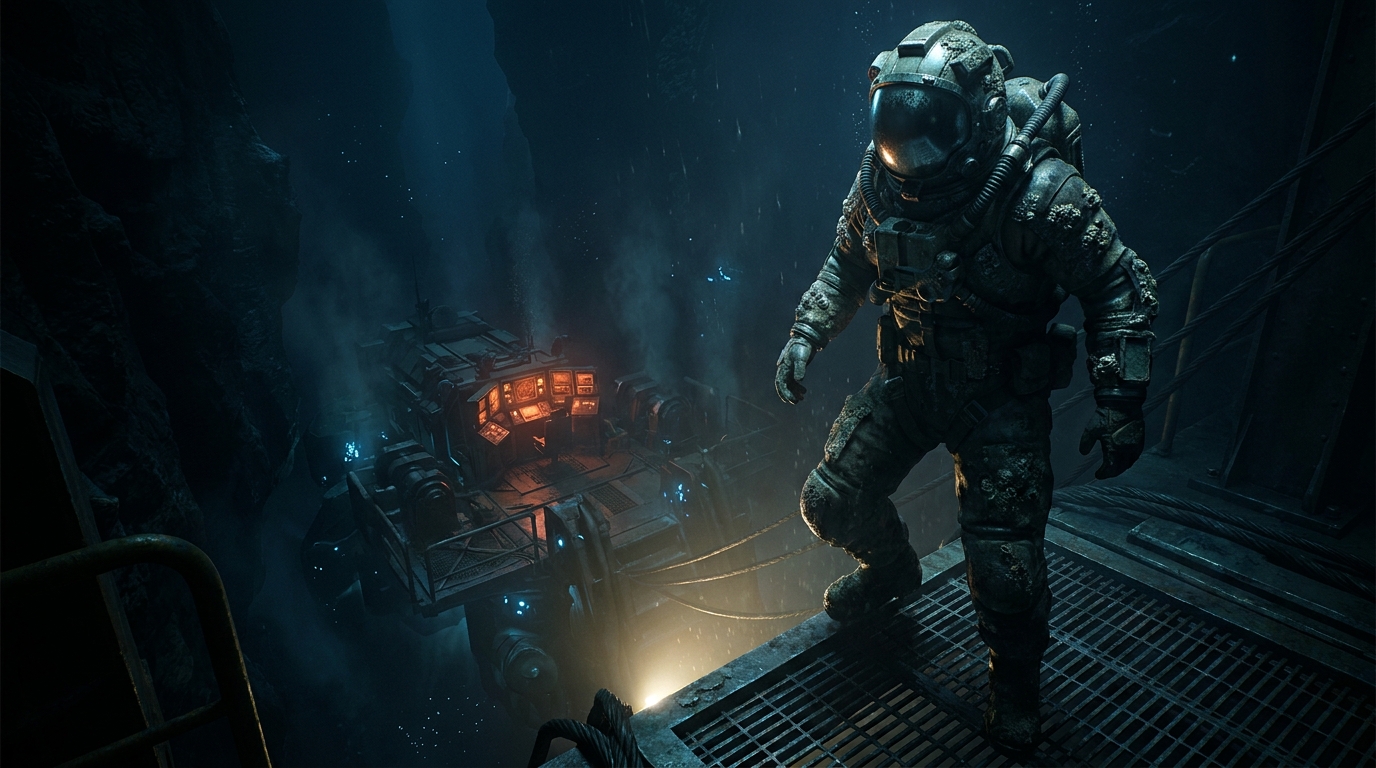
Key art for Trenchwatch: Abyssal trench frontier, first-person tactical register, cinematic dark obsidian-and-ember key art, non-human subject per the studio's art-direction constraint, no photoreal human face, demo only

In production · First-person tactical

Trenchwatch

The frontier is the deep.

The pitch

Trenchwatch is a first-person tactical action game set on a deep-ocean frontier. The player joins a salvage operation working an abyssal trench at frontier-pressure depths; the trench is not empty. Salvage turns into survival when something at depth registers the operation as a threat.

Ironhold's third title, currently in production. No announced release window.

Specifications and credits

Register
First-person tactical
Setting
Abyssal trench frontier
Status
In production
Platforms
PC, PlayStation 5, Xbox Series X / SDemo

Game director: P. VaszaryTechnical director

Wishlist for release.

All games

Demo only; no purchase, wishlist, or storefront action is taken

Ironhold is a fictitious AAA-adjacent action studio built as a RampStack showcase demo. All titles, team members, open roles, and press mentions are demo-fictitious. Ironhold does not exist as a real studio, the titles do not exist as real games, and the team does not exist as real people. No applications are processed, no wishlists are taken, and no payments are processed.

RampStack

Built by the RampStack trinity

How Ironhold was built

The four-stage workup behind this corporate portfolio demo, summarized. Generalized and pattern-level; no named competitors. The full Format A spec and the verification log live in the operated-side run record.

Stage 01

Basano · competitor review

  • The AAA-adjacent action studio field clusters in a fairly narrow register at the chrome layer: dark-mode-first sites where the chrome composes and the game key art carries the saturation and the energy. The home opens with a single cinematic full-bleed shot; the titles strip presents the studio's portfolio at scale; the studio page presents the team, the craft, and the workplace; the careers page is the conversion surface for the AAA talent funnel; the press page collects interviews and the studio's voice on its own work.
  • The position the field leaves on the table is not a position the field neglects; it is a register the showcase engine had not yet practised. Every one of the 11 shipped demos before Ironhold sat outside Bold Confident. The standout this build targets is the register itself: a cinematic full-bleed hero with the title's key art carrying saturation and motion-implied composition, type at scale and confidence, a dark ground with a single high-energy accent that the chrome uses sparingly. Bold means visually committed, not loud-for-loud's-sake; the chrome restraint (the Editorial Restrained composition secondary) is what keeps the studio brand from tipping into the single-IP saturation that belongs to a game-title demo.
  • Structural standouts the field consistently leaves available cluster on the titles portfolio and the careers surface. First, a title detail page that treats each game with the gravity of a small monograph (key-art hero, tagline, short pitch, gameplay register named, the team's relationship to it). Second, a careers surface that names the studio's hiring posture and what the studio expects of itself as a workplace, in the studio's own voice rather than as a recruiting pitch. Third, a studio page that presents the team without fabricated headshots, the way an editorial publication presents its masthead.
  • Voice standouts the field leaves available cluster on craft-and-scale pride without arrogance. The field leans toward two voice failure modes: hype-marketing cliche on the one side, corporate-flat blandness on the other. A studio voice that names what it built, who built it, and how it was made, in plain confident sentences, reads as bold without performing it.
  • Honesty signals available to a new entrant cluster on disclosure. The field traditionally surfaces review-aggregator scores, sales numbers, awards lists, and selected press quotes. A studio that does not surface scraped or fabricated review aggregates, that names its press coverage at the source-level rather than as a score, and that says when a title is in development versus shipped, signals editorial discipline at a register the field has not always practised.

Stage 02

Krine · positioning

Position
Bold-confident, editorial-restrained AAA-adjacent action studio. The studio chrome is composed and dark-mode-first; the game key art carries the saturation and energy. Cinematic full-bleed hero, four fictitious titles as a coherent body of work, the team as a typographic masthead (no headshots), careers as the load-bearing conversion surface, multi-column-sitemap footer. Bold Confident leads with Editorial Restrained as composition secondary; pure Bold Confident and Vibrant Saturated rejected to leave headroom for the upcoming game-title demo; Documentary Honest and Technical Precise secondaries considered and rejected per the brief. Vertical anti-patterns from the gaming and entertainment vertical file (Clinical Trustworthy, Rugged Utilitarian outside sim, Luxe Considered in mass gaming) confirmed not selected. Selected via the creative-brief-selector skill; full brief at progress/corporate-portfolio-ironhold-brief.md. First portfolio entry in Bold Confident; first portfolio entry in the corporate-portfolio shape. The brief takes the first Rule 4 WARN override in the framework's history (full-bleed-image-with-overlay hero; canonical AAA-studio treatment; four shipped matches but no archetype-family share so Rule 5 does not block; override justified because the new archetype carries the shape into a completely different visual reading).
Archetype
bold-confident-aaa-game-studio
Voice
Bold, cinematic, confident. Craft-and-scale pride without arrogance. Third-person where the studio speaks; first-person plural in deeper studio surfaces. Plain confident sentences. Names what is there. No hype-marketing cliche (no legendary, no iconic, no epic, no unforgettable, no next-level, no breakthrough). No corporate-flat blandness either.

Stage 03

Tholo · build plan

home

  • creative-brief-selector
  • competitor-experience-audit
  • vertical-site-conventions
  • landing-page-copy
  • information-architecture
  • frontend-component-build
  • seo-onpage

titles

  • frontend-component-build
  • information-architecture

title detail (dynamic)

  • creative-brief-selector
  • frontend-component-build
  • landing-page-copy
  • seo-onpage

studio

  • landing-page-copy
  • frontend-component-build

careers

  • landing-page-copy
  • frontend-component-build

workup

  • landing-page-copy
  • frontend-component-build

Stage 04

Basano · verification

Holds(13)

  • Heading hierarchy holds across all six pages: exactly one H1 per page, H2 / H3 sequence with no skipped levels.
  • Language declaration, semantic landmark structure (header, main with id=main-content, footer, nav with aria-label), and the skip-navigation link via ShowcaseMetaLayer are all present and correctly wired across the microsite.
  • JSON-LD Organization on the layout with Brand subOrganization for Ironhold; CreativeWork on the layout. BreadcrumbList on every non-home page. ItemList on home and titles pages. VideoGame schema on every title detail page with name, genre, platforms, and publisher reference; no fabricated aggregateRating. AboutPage on the studio page.
  • Hero zone carries the full-bleed-image-with-overlay shape per the brief's Rule 4 WARN override: a single cinematic full-bleed key-art frame of the marquee title (Mariner's Gauntlet) fills the hero on first paint with a lower-left overlay block (status / register micro-label, title at extra-large Inter Tight 800 with negative tracking, tagline, short pitch, Explore-the-title primary CTA in Ember plus View-all-games secondary). No carousel of multiple key-art frames cycling.
  • Titles portfolio strip renders the four fictitious titles (Mariner's Gauntlet, Steeltide, Trenchwatch, Northcrest) as a coherent body of work with consistent card anatomy: key-art tile, register and status micro-label, title in Inter Tight display, tagline, setting line in Ember micro-label. Same anatomy across all four cards so the portfolio reads as one studio's output.
  • Title detail pages render the monograph anatomy with KEY ART ONLY per the brief's 3A key-art-only decision: a full-width key-art frame at top with the title at extra-large Inter Tight 800 and tagline; the pitch paragraphs in Inter body at 18 pixels with 1.7 line-height; specs and credits in a four-cell dl (register, setting, status with year, platforms); game director credit linking to the studio masthead; demo-only Wishlist / View-on-storefront conversion CTA per the title's status. No in-game-capture image slots anywhere in the build.
  • Studio page renders the team as a typographic masthead organized by discipline (Leadership, Engineering, Art, Design, Production, Audio, QA, Operations) with role-and-name listings and NO headshots. 35 representative names from a stated 62-person studio; the gap between representative and total is named in copy as deliberate convention (roster-not-personality).
  • Careers page renders 10 fictitious open roles by discipline, each with a one-paragraph description in the studio's voice and a demo-only Apply button labelled in Ember.
  • Press band (home only, no standalone press page per the brief's 3A press decision) renders 3 brief source-and-date lines for fictitious publications. No fabricated review scores, no fabricated pull quotes, no real-outlet names. The publication names do not echo any real gaming-press outlet.
  • Bold-confident-cinematic register held: dark-mode-first Obsidian (#0b0d11) page ground; Slate (#1a1f2a) and Iron (#2a3140) secondary surfaces; Steel and Ash and Bone as the type-color stack; Ember (#d4503a) as the single high-energy accent used sparingly on CTAs, demo-only labels, and key-art frame highlights. Inter Tight (700 and 800) for display and the wordmark; Inter (400 and 500) for body and chrome. Brand wordmark in Inter Tight 800 uppercase at tracking-[-0.02em] (negative tracking; the first negative-tracked wordmark in the portfolio; tight and dense). The register reads cinematic-bold rather than restrained-in-dark-mode: type at scale (hero overlay at 48 to 64 px on dark, page H1 at 56 to 72 px), full-bleed key art carrying saturation, Ember marking active points only.
  • Footer renders the multi-column-sitemap shape: brand column plus five link columns (Games, Studio, Careers, Community, Legal). Studio-corporate breadth; distinct from FitFirst's parts-retail commerce-deep multi-column footer (same structural shape, different content). Demo-only labels in Ember on Community and Legal placeholders. Footer chrome convention applied (no outer margin; inner padding absorbs the spacing; the dark footer ground sits flush against the dark page above).
  • Honesty contract held throughout: no fabricated human faces anywhere (studio band and studio page are typographic with no headshots). All 35 team names and all 4 title names vetted against the brief's exclusion lists (gaming, film, industry figures for team names; high-resemblance-risk franchises for title names: Halo, Destiny, Call of Duty, Apex, Cyberpunk, Doom, Gears of War, Battlefield, Valorant, Overwatch, Diablo, The Last of Us, Uncharted, Dark Souls, Elden Ring, God of War, Horizon, Ghost of Tsushima, Spider-Man, Death Stranding, Metal Gear, Alan Wake, Control, Mass Effect, Dragon Age). Non-human key-art constraint stated in every Image alt and in the thumbnail alt so Phase 3B inherits it. Demo-only labelling in Ember on every interactive surface.
  • SITE_SHAPES enum extended to twelve shapes with corporate-portfolio added as the canonical shape for studio/agency/firm corporate-presence sites. SITE_SHAPE_LABELS updated. The showcase-index shape filter picks up the new shape.

Fails(6)

  • Intentional noindex and nofollow on the demo build (correct for a demo, flagged by the verifier across pages against a production-ready standard). Same not-a-defect-in-context the prior demos carry.
  • Canonical URL declares the production rampstack.co host while the build is served from localhost during the audit; cross-origin canonical mismatch is the localhost-vs-production artefact, not a real defect. Recurring across all pages.
  • Title tags and H1s on inner pages lean structural (Games, Studio, Careers, Workup) rather than search-keyword-aligned. Judgment item for the showcase context; a live AAA studio would target its lead title and its franchise terms explicitly.
  • Key-art placeholder imagery state (typographic SVGs over dark grounds) flagged against a production photography or illustration standard; intentional pre-imagery state. Phase 3B replaces the placeholders with cinematic key art per the brief's image-ready spine (1 hero + 4 title-strip + 4 title-detail heroes; non-human subject constraint binding; key art only, no in-game captures).
  • Logo-less type lockup; the Inter Tight 800 negative-tracked uppercase wordmark over Obsidian is the type-led placeholder this batch ships with. The logo pass is a separate per-brand later dispatch.
  • Non-marquee titles render a lighter monograph anatomy than the marquee (Mariner's Gauntlet carries four pitch paragraphs and the full credits; the others carry two or three pitch paragraphs and the same credits anatomy). Intentional for the demo's marquee-full convention.

Not assessable(6)

  • Core Web Vitals and page experience (no field data in a static-fetch audit).
  • robots.txt and XML sitemap content (single-page audit does not crawl).
  • Real titles / CMS backend integration (none in this build by design; titles, team, and roles are static modules).
  • Real careers-application backend integration (intentionally absent; Apply buttons are demo-only).
  • Real wishlist / storefront integration (intentionally absent; conversion buttons on title detail are demo-only).
  • Mobile responsiveness past basic reflow at the audit viewport (separate device captures required).