Gallery

The world in stills.

Key art only. Mariner's Gauntlet carries no trailer, no developer-diary video, and no in-game capture on this site; the stills carry the world.

Key art

The marquee frame.

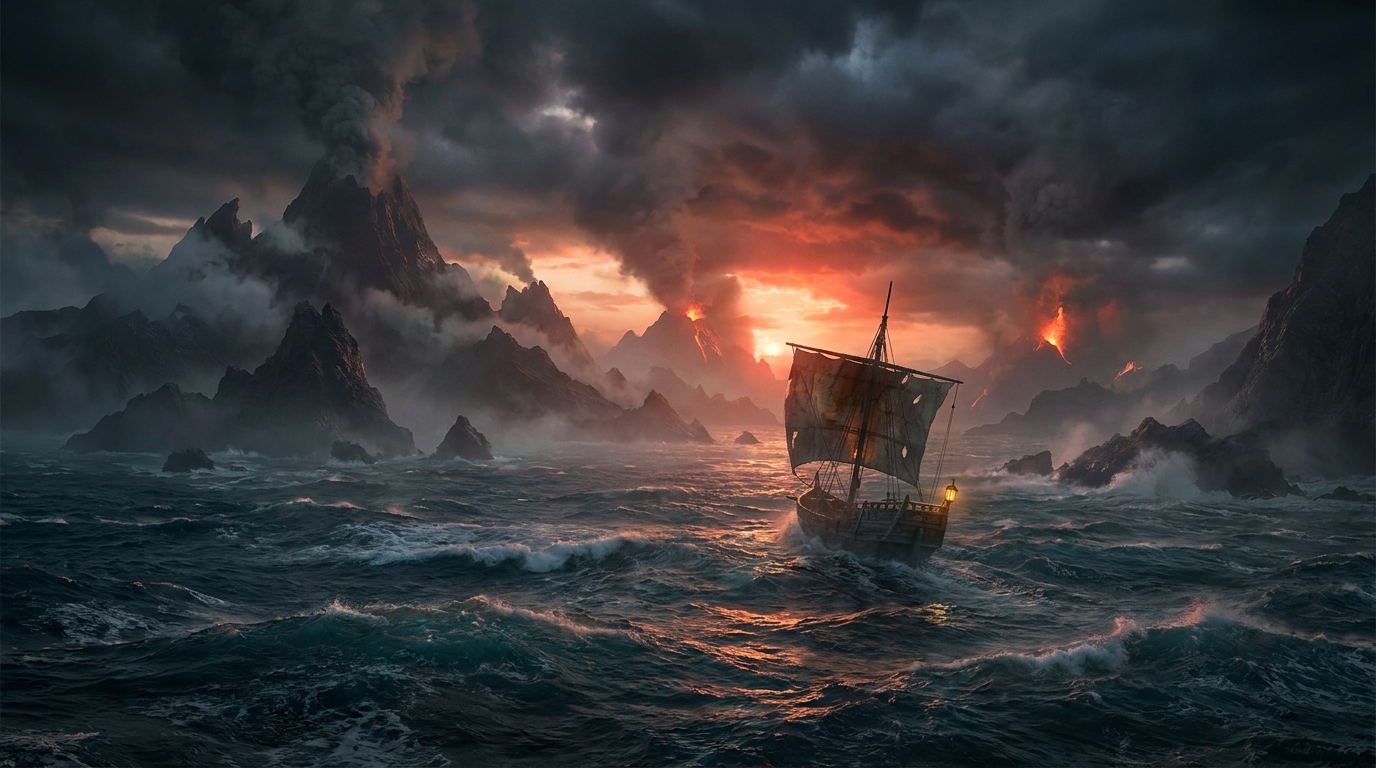
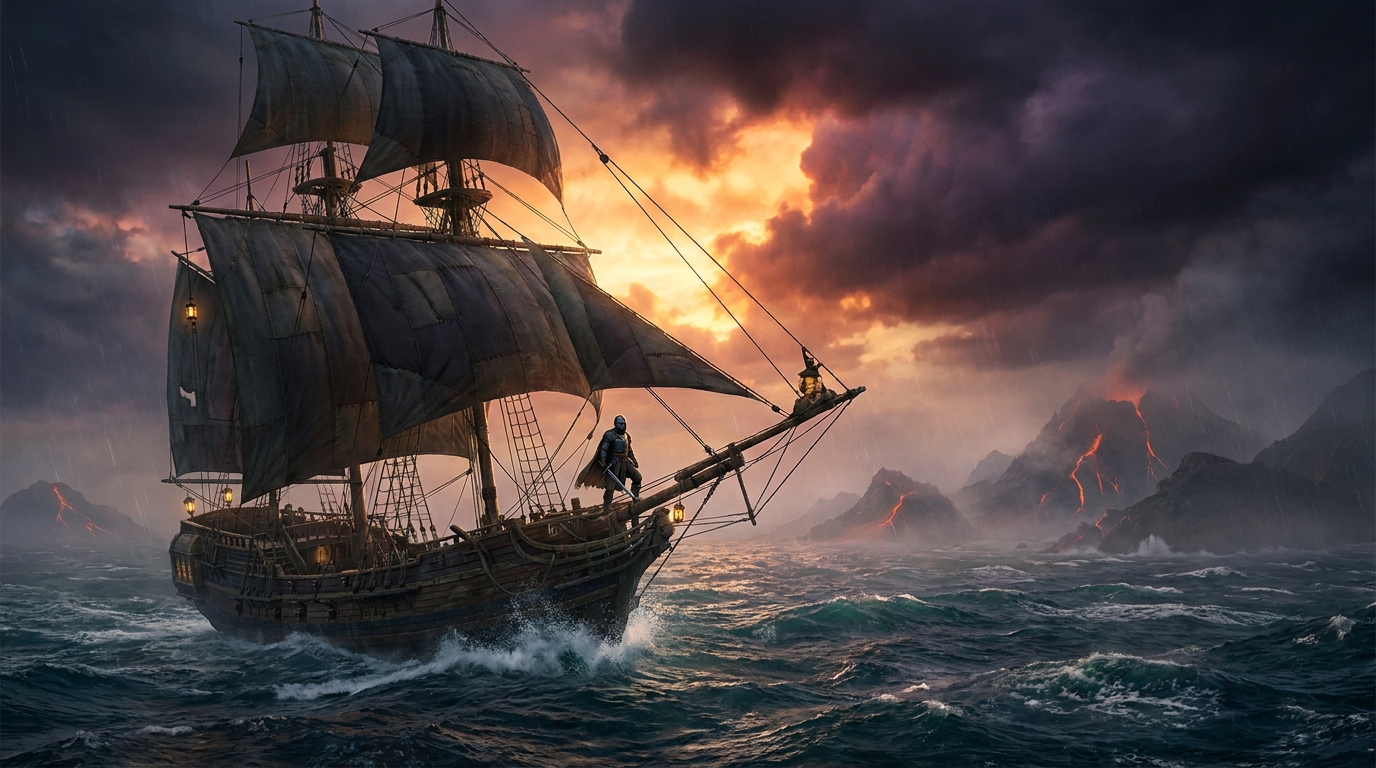
  • Key art: a single light frigate cutting the swell at first light in a storm-tossed volcanic archipelago, the helmeted explorer-warrior at the bow facing the islands rising in layered haze, ember dawn breaking on the horizon, sword sheathed at the warrior's side, non-human subject per the title's art-direction constraint, no photoreal human face, no real brand marks, no title lettering, demo only
    First light over the Reach.

The sequence

Five world moments. Key art, not footage.

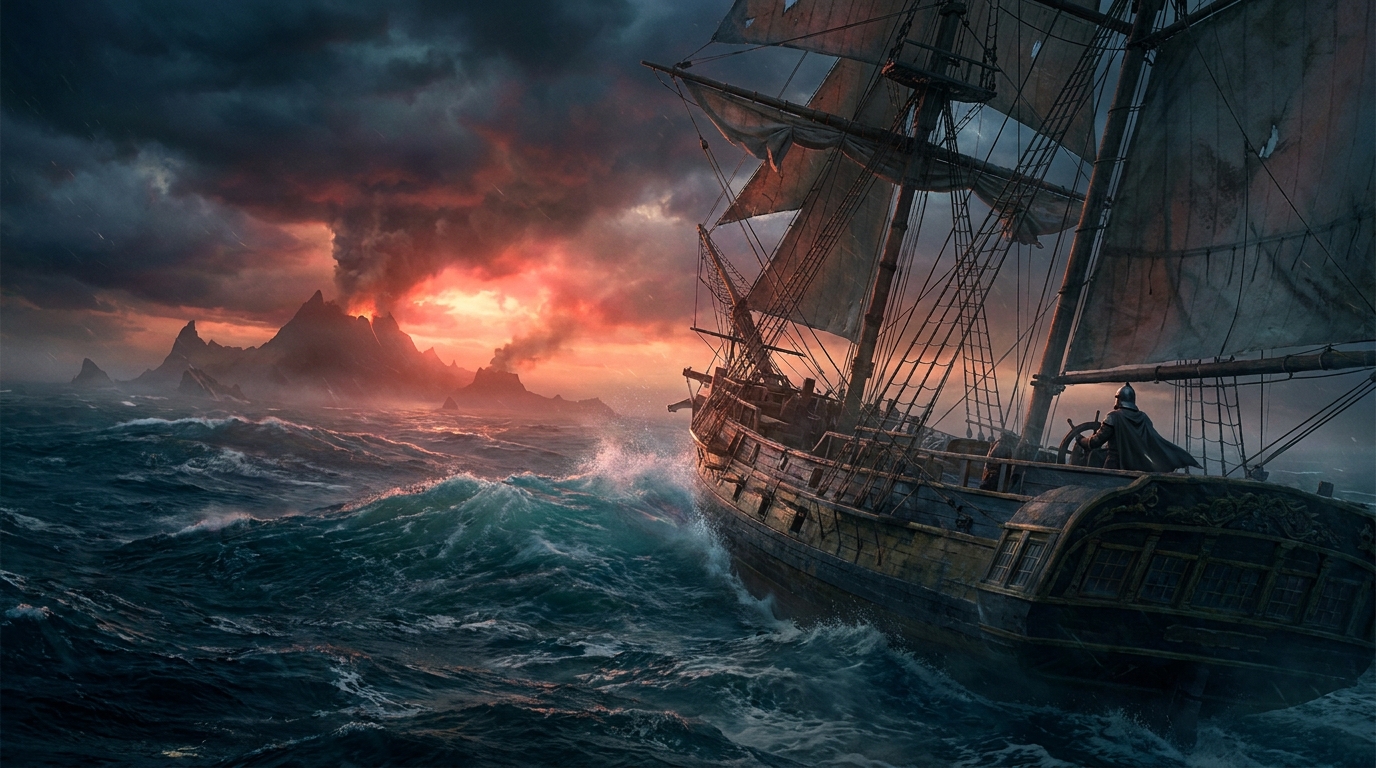
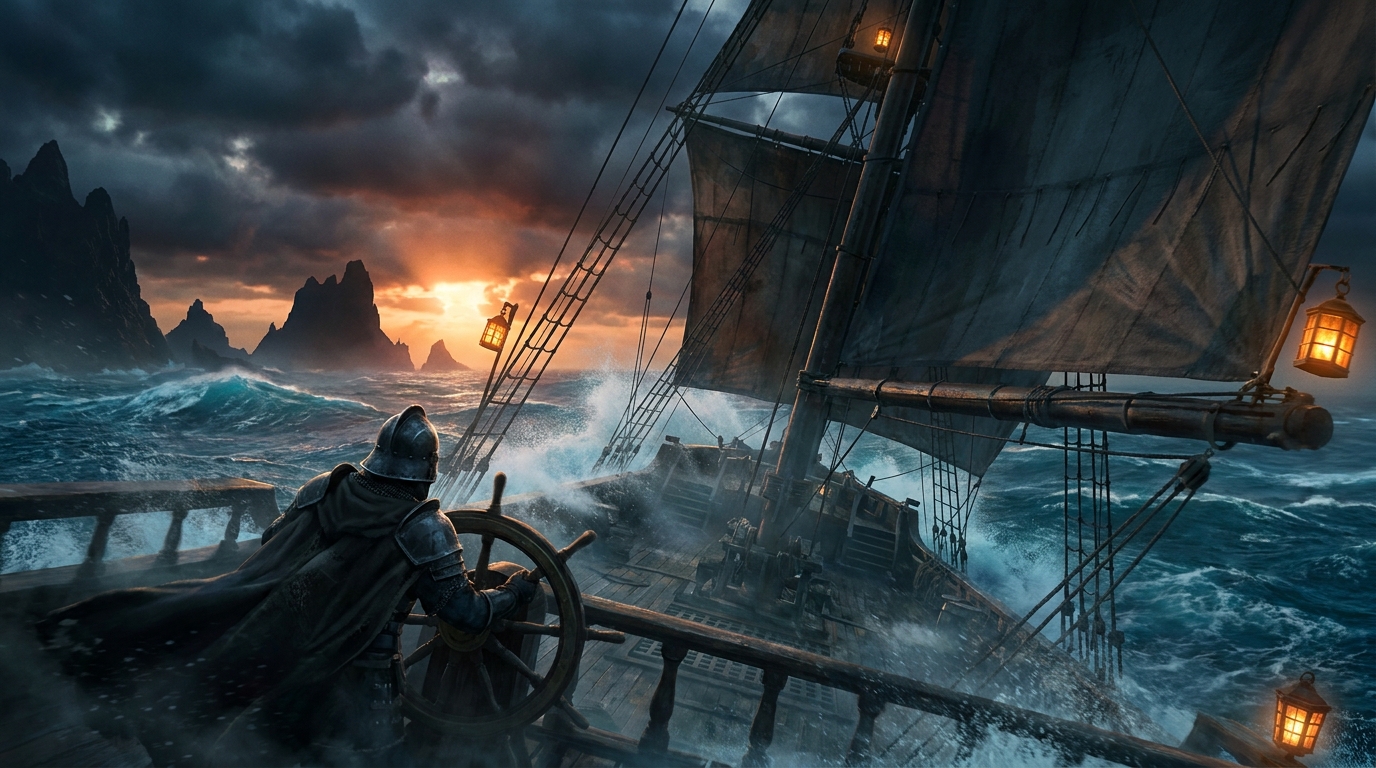
  • Key art: an open-ocean storm passage, the light frigate heeling hard in a towering blue-green swell under a bruised sky, sea spray across the deck, the helmeted figure braced at the wheel, non-human subject per the title's art-direction constraint, no photoreal human face, no real brand marks, no title lettering, demo only
    Open water keeps no promises.
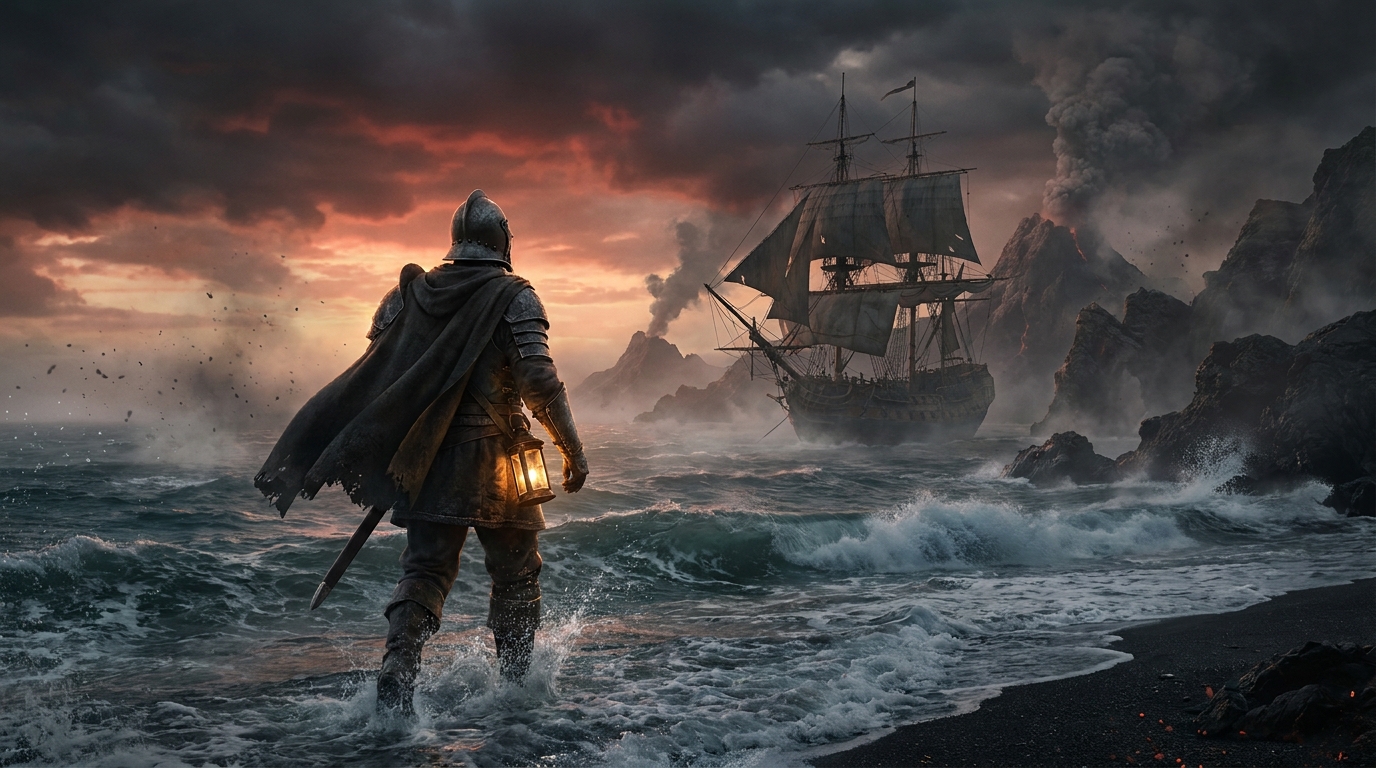
  • Key art: a volcanic landfall, black-sand shore under a drifting ash plume and an ember sky, the helmeted explorer-warrior wading ashore with sword sheathed, the frigate anchored in the bay behind, non-human subject per the title's art-direction constraint, no photoreal human face, no real brand marks, no title lettering, demo only
    Make landfall light.
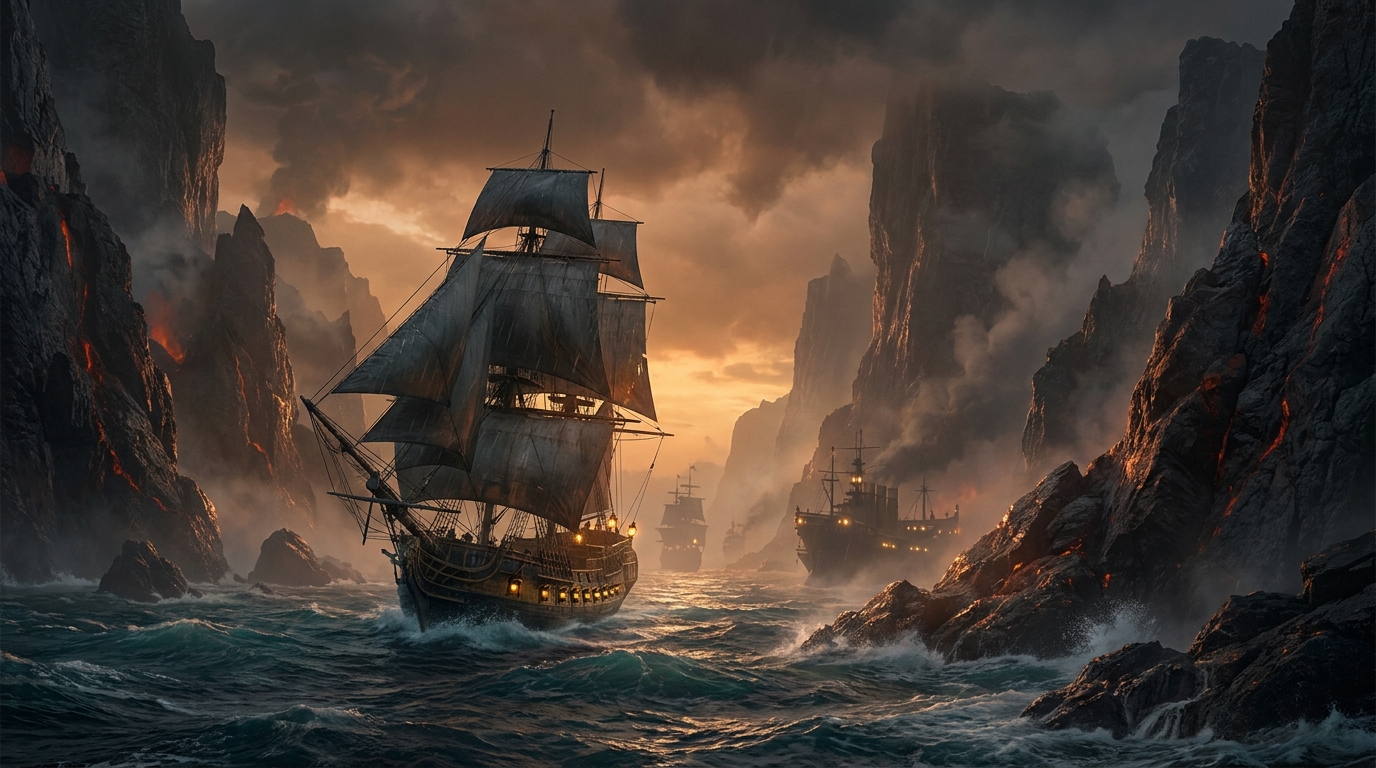
  • Key art: a blockade run at dusk, the frigate threading a narrow volcanic strait between tall iron-grey hulls, ember dusk light raking the rock walls, lantern fire on the far hulls, no visible faces, non-human subject per the title's art-direction constraint, no photoreal human face, no real brand marks, no title lettering, demo only
    Thread the Narrows or turn back.
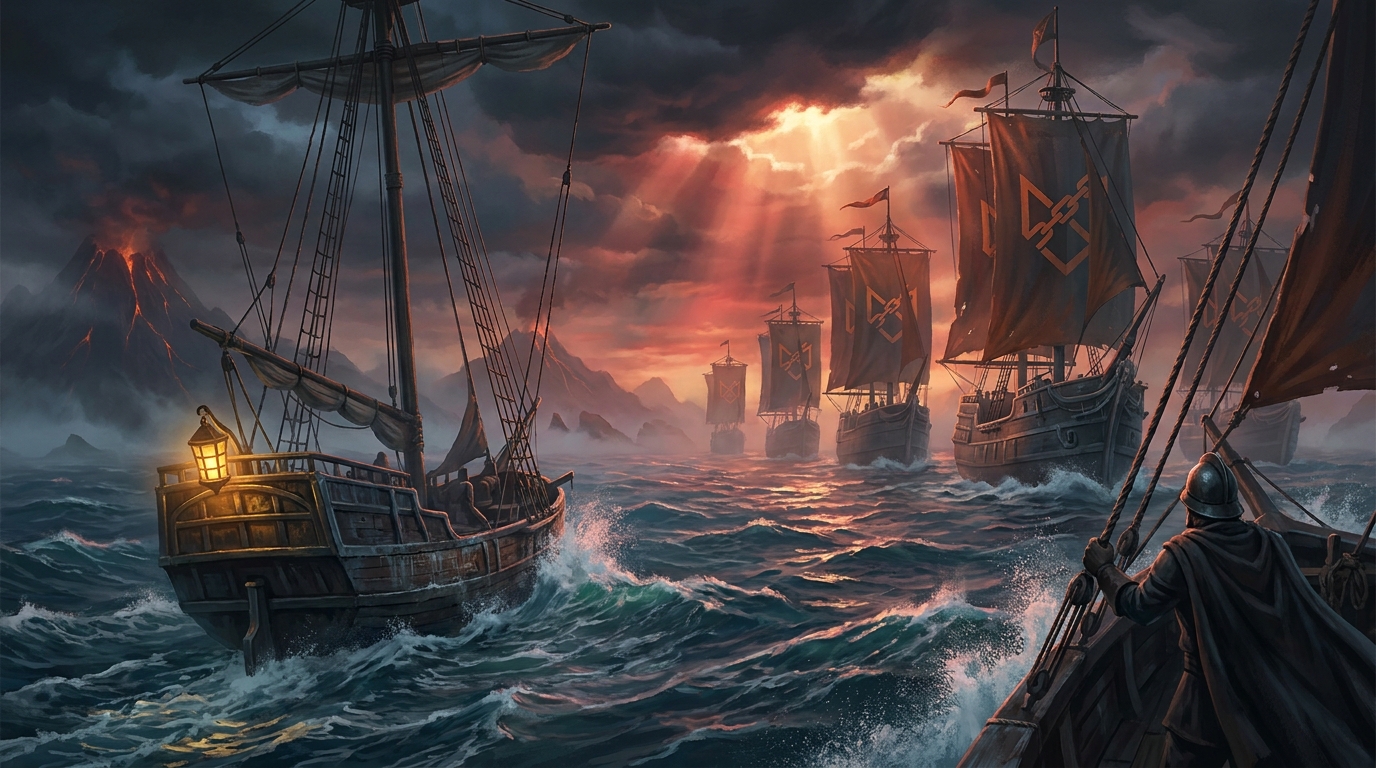
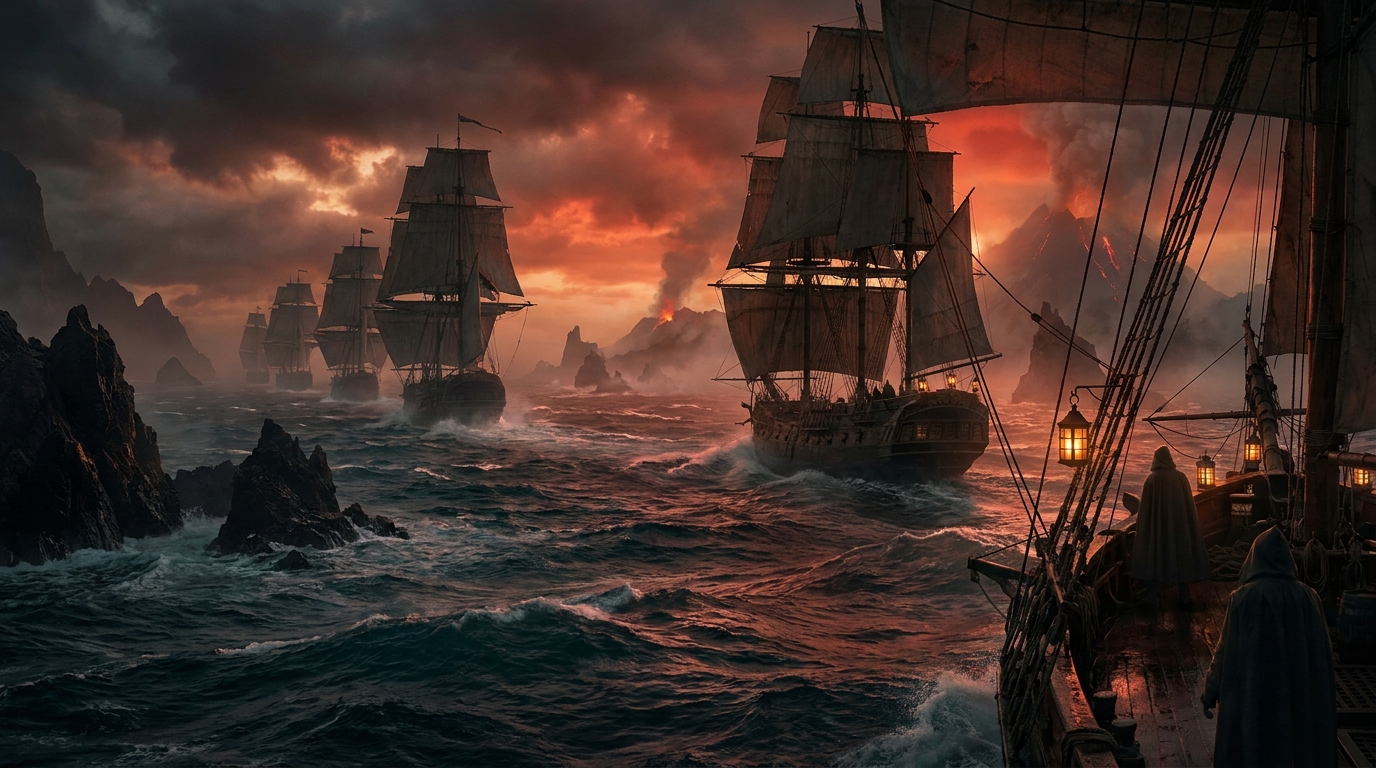
  • Key art: the tribunal's fleet on the horizon, a line of tall hulls flying broken-chain banners across a leaden blue-green sea, the lone frigate small in the foreground, non-human subject per the title's art-direction constraint, no photoreal human face, no real brand marks, no title lettering, demo only
    The fleet is your sentence.
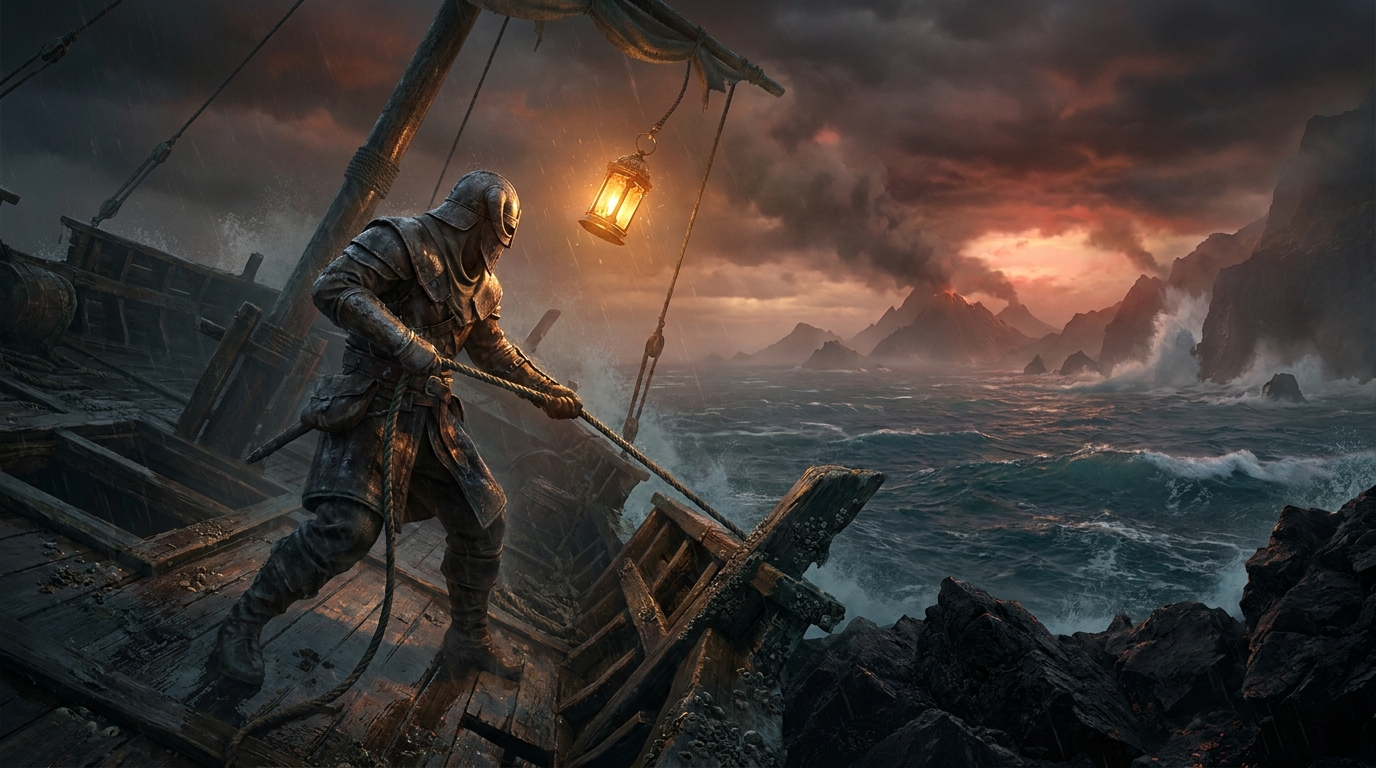
  • Key art: salvage in hostile waters, a half-sunk wreck on a black reef under lantern light, the helmeted warrior on the listing deck hauling a line, storm light behind, non-human subject per the title's art-direction constraint, no photoreal human face, no real brand marks, no title lettering, demo only
    The sea keeps the ledger.

The world

Regions and peoples.

  • Key art: a wide establishing vista of the archipelago, volcanic islands rising in layered haze across a deep blue-green sea at first light, ember dawn on the far peaks, no figures, non-human subject per the title's art-direction constraint, no photoreal human face, no real brand marks, no title lettering, demo only
    An archipelago that learns you back.
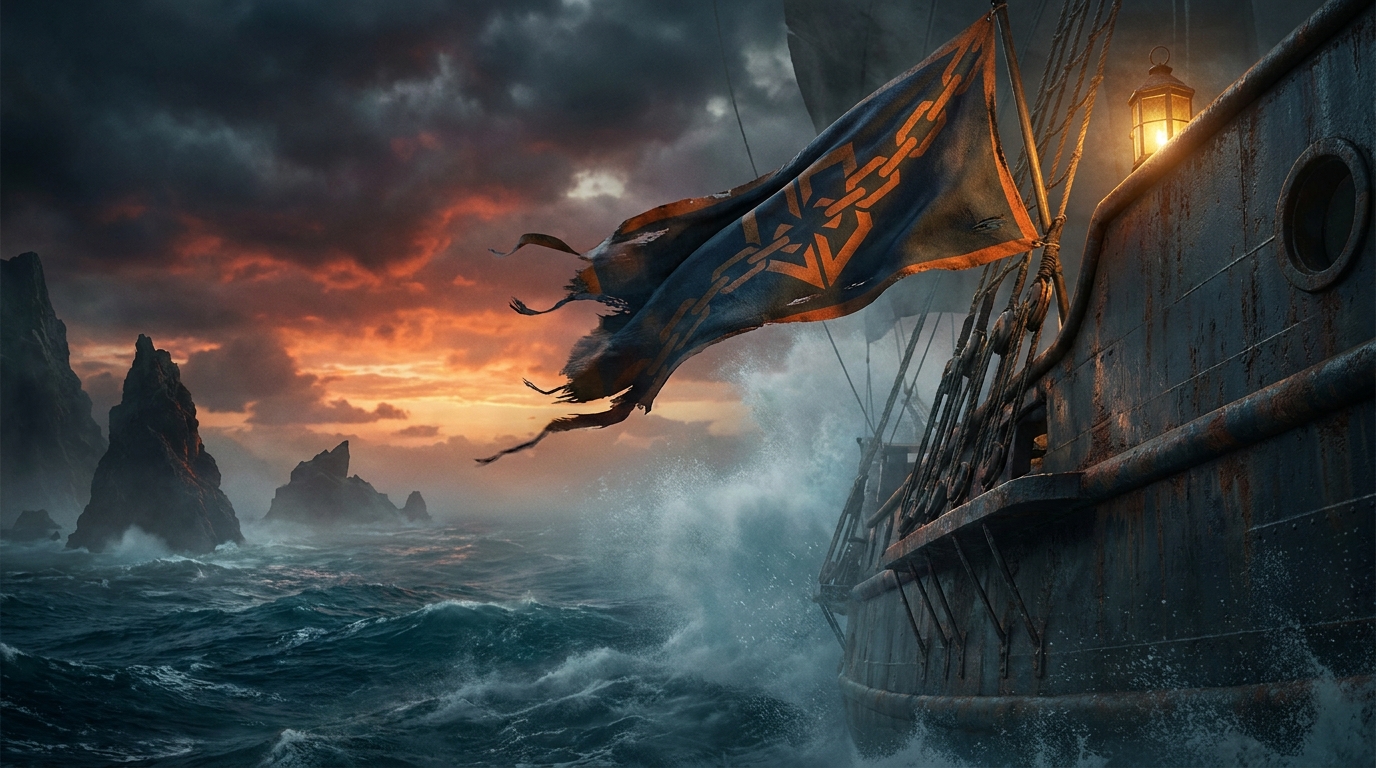
  • Key art: a broken-chain banner of the Tribunal Fleet snapping in the wind above the rail of a tall iron-grey hull, storm light behind, no figures and no faces, non-human subject per the title's art-direction constraint, no photoreal human face, no real brand marks, no title lettering, demo only
    The Tribunal Fleet.
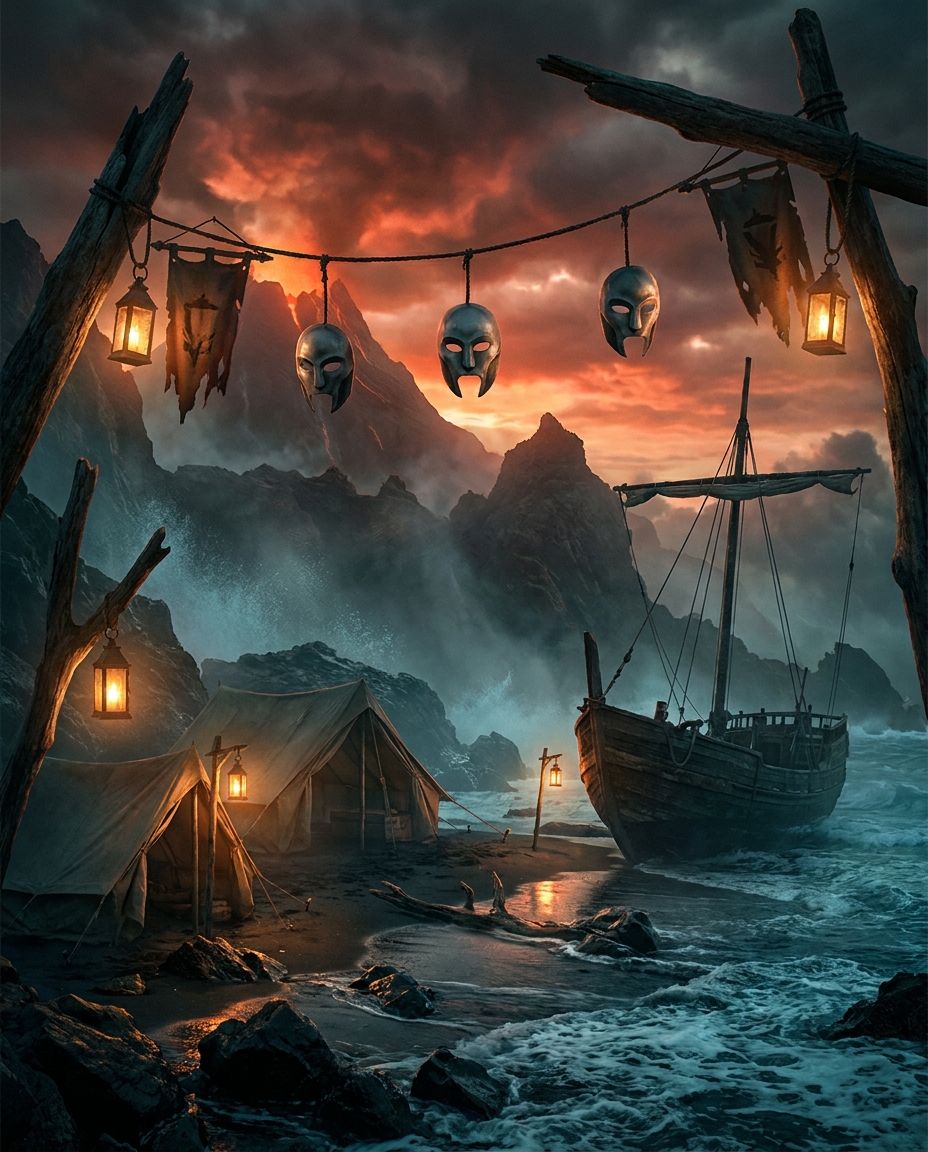
  • Key art: a Reach Wardens coastal camp at dusk, bone-and-iron masks and lantern banners hung on driftwood frames above a black-sand cove, lantern fire, no figures and no faces, non-human subject per the title's art-direction constraint, no photoreal human face, no real brand marks, no title lettering, demo only
    The Reach Wardens.

Gameplay

Key art suggesting the systems. No captures.

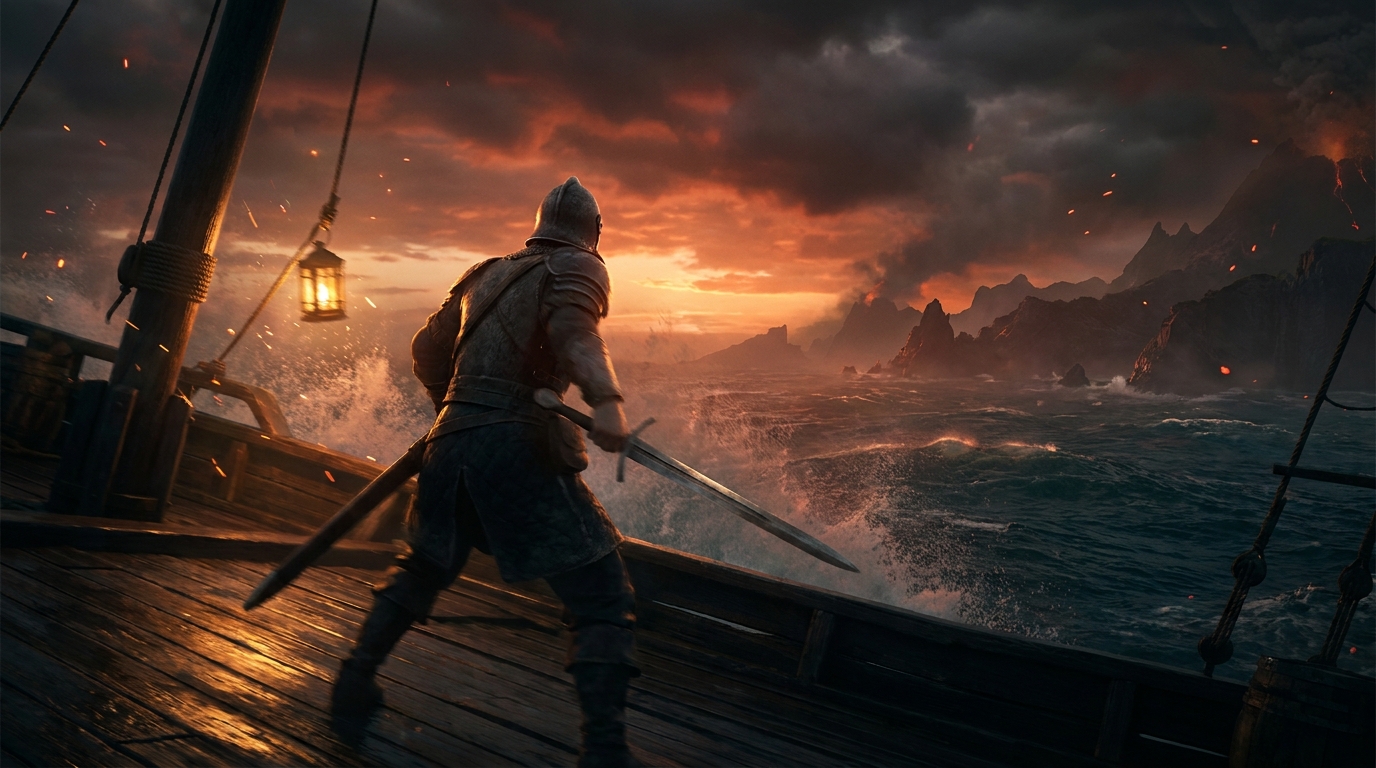
  • Key art suggesting on-foot combat: a sword drawn in profile silhouette on a storm-lit deck, the helmeted warrior mid-stance with motion implied, no HUD and no interface, non-human subject per the title's art-direction constraint, no photoreal human face, no real brand marks, no title lettering, demo only
    Combat is naval first, on foot second.
  • Key art suggesting naval navigation: the frigate in a storm passage with sails reefed and the wheel hard over, sea spray and a bruised sky, no HUD and no interface, non-human subject per the title's art-direction constraint, no photoreal human face, no real brand marks, no title lettering, demo only
    The wheel is yours.
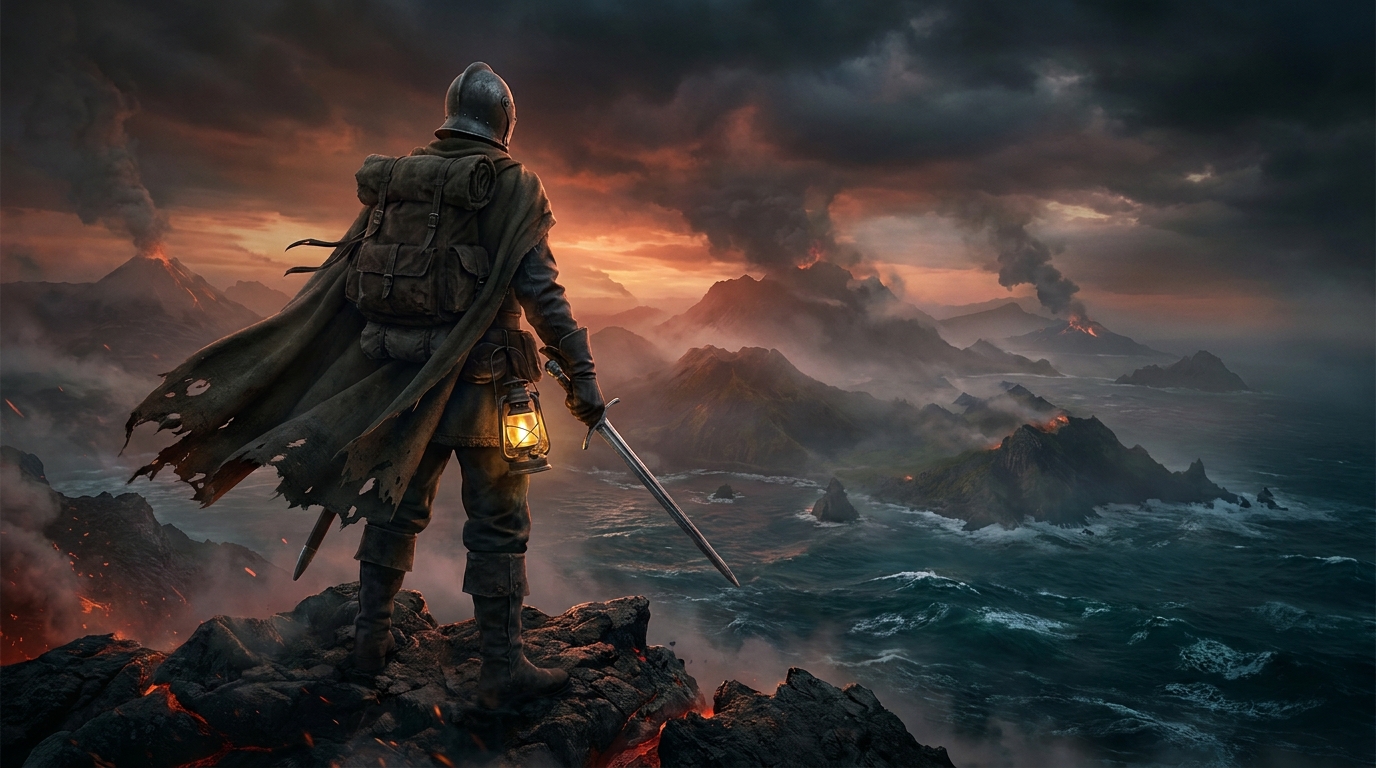
  • Key art suggesting exploration: the helmeted warrior on a cliff edge surveying an unmapped chain of volcanic islands, sword sheathed, wind-blown, no HUD and no interface, non-human subject per the title's art-direction constraint, no photoreal human face, no real brand marks, no title lettering, demo only
    The map fills in behind you.
  • Key art suggesting the run structure: a fleet formation at the storm's edge, several tall hulls in line ahead under an ember sky, the lone frigate apart from them, non-human subject per the title's art-direction constraint, no photoreal human face, no real brand marks, no title lettering, demo only
    A fleet's worth of work, alone.

Follow the journey

New waters, new runs. Follow the title.

Demo only; no follow is recorded and no email is sent

Mariner's Gauntlet is a fictitious AAA action title built as a RampStack showcase demo. It does not exist on any real platform, no wishlists or follows are processed, and no payments are taken. Published by Ironhold, a fictitious AAA-adjacent action studio that also exists only as a RampStack showcase demo.

Archivo and Archivo Expanded by Omnibus-Type, via Google Fonts. © Mariner's Gauntlet demo. RampStack showcase. No real title exists.

RampStack

Built by the RampStack trinity

How Mariner's Gauntlet was built

The four-stage workup behind this single-ip marketing demo, summarized. Generalized and pattern-level; no named competitors. The full Format A spec and the verification log live in the operated-side run record.

Stage 01

Basano · competitor review

  • The AAA single-IP marketing field clusters tightly. A published action title runs a dark-mode-first marketing site that opens on a single cinematic frame (a trailer, conventionally), then immerses the visitor in the world (the setting, the lore, the regions), then names what the game is (the systems, the register), then surfaces media (the key-art gallery), then closes on the conversion (storefront, follow). The site is the content's own brand: where a studio portfolio composes and recedes to let many titles share a body of work, the single-IP site commits fully to one world and lets the saturation carry.
  • The position the field leaves on the table for this build is not a field gap; it is a register the showcase portfolio reserved. The paired studio demo deliberately composed with a chrome-restraint secondary precisely so this title could claim the saturated leap without colliding. The standout this build targets is the saturated single-IP register itself: type at title-card scale, palette depth that carries the world's own tones rather than the publisher's neutral chrome, key art treated as the page's load-bearing element, and a hero that reads as a launch poster rather than a portfolio frame.
  • Structural standouts the field consistently leaves available cluster on the world-immersion surface and the trailer slot. First, a world page that treats the setting as the protagonist (the regions, the peoples, the era) rather than as a backdrop, written in the game's own voice. Second, the trailer-slot problem: the field leads with video, and a build without video must replace the trailer with a curated key-art sequence that carries the cinematic register the trailer would carry. The replacement is a standout, not a compromise, when the sequence is composed as a deliberate run of world moments.
  • Voice standouts cluster on world-forward immersion. The field's two failure modes are hype-marketing cliche on one side and feature-list flatness on the other. A voice that is the game talking from within its own world, second-person where the player is addressed and third-person where the world is described, reads as immersive without performing it. This is distinct from a studio's craft-pride voice: the studio talks about the game, the title talks from inside it.
  • Honesty signals available to a post-launch entrant cluster on reception discipline. A released title traditionally surfaces review-aggregator scores, sales numbers, player counts, and post-launch changelogs. A site that speaks about a world that has already shipped without fabricating any of its post-launch reception signals editorial discipline at a register the field rarely practises.

Stage 02

Krine · positioning

Position
Bold-confident, vibrant-saturated single-IP marketing site for a post-launch AAA action title. The title side of the Ironhold pair: it claims the saturated single-IP register the studio brief reserved as forward-divergence headroom. Bold Confident leads (shared with Ironhold for pair-coherence); Vibrant Saturated is the composition secondary (the saturated leap: a blue-green ocean ground, a hotter higher-chroma ember, a ship-lantern gold the studio chrome did not carry, type at title-card scale, key art as the load-bearing surface). Pure Bold Confident considered and rejected (would under-differentiate the title from its own publisher on the secondary axis); Vibrant-Saturated-as-lead rejected (tips into the casual or community register the gaming vertical marks wrong for AAA action); Editorial Restrained as secondary rejected (that is the studio's composition). This is the first pair-coherence-mode build in the portfolio: the studio is composed-cinematic and the title is saturated-maximal by design, two expressions of one world. The hero shape is centered-single-column (a cinematic launch poster), selected because full-bleed-image-with-overlay is BLOCKED under the framework's Rule 5 (five shipped matches plus a shared Bold Confident family with the publisher Ironhold): the framework's first Rule 5 BLOCK against a same-pair shipped demo. Selected via the creative-brief-selector skill; full brief at progress/single-ip-marketing-mariners-gauntlet-brief.md.
Archetype
bold-confident-single-ip-game-title
Voice
World-forward and lore-immersive: the voice of the game itself, not the studio's craft-pride. Second-person where the player is addressed, third-person where the world is described, sparingly first-person where lore demands. Plain confident sentences that evoke the archipelago, the helmeted warrior, the storm-tossed seas, the ember dusk, and the tribunal's sentence without hype-marketing cliche. The studio talks about the game; the title talks from inside it.
Stage 03

Tholo · build plan

home

  • creative-brief-selector
  • competitor-experience-audit
  • vertical-site-conventions
  • landing-page-copy
  • information-architecture
  • frontend-component-build
  • seo-onpage

world

  • creative-brief-selector
  • landing-page-copy
  • frontend-component-build
  • seo-onpage

gameplay

  • landing-page-copy
  • frontend-component-build

media

  • frontend-component-build
  • information-architecture

workup

  • landing-page-copy
  • frontend-component-build

Stage 04

Basano · verification

Holds(14)

  • Heading hierarchy holds across all five pages: exactly one H1 per page, H2 / H3 sequence with no skipped levels.
  • Language declaration, semantic landmark structure (header, main with id=main-content, footer, nav with aria-label), and the skip-navigation link via ShowcaseMetaLayer are all present and correctly wired across the microsite.
  • JSON-LD Organization with Brand subOrganization for Mariner's Gauntlet on the layout, with a publisher reference to Ironhold; VideoGame schema on the layout and home with name, genre Third-person action, datePublished 2024, and publisher referencing Ironhold. No aggregateRating (no fabricated review aggregates). No Offer with fabricated platform URLs. BreadcrumbList on every non-home page. CollectionPage on the world page, AboutPage on the gameplay page, ImageGallery on the media page.
  • Hero zone carries the centered-single-column launch-poster shape per the brief: a single cinematic key-art frame (the ship-at-dawn composition, a different frame from the publisher's outcrop-at-dusk hero) opens the hero, the title MARINER'S GAUNTLET set in Archivo Expanded at title-card scale (96 to 144 pixels on desktop) centered below the image, the tagline The fleet is your sentence, the Released 2024 status, and a single demo-only storefront CTA, all in a centered column. No carousel; no overlay block; the type sits below the image as a launch-poster lockup, not overlaid via a gradient.
  • The key-art sequence replaces the conventional trailer slot: five stills, each a different world moment (open-ocean storm passage, a volcanic landfall, a blockade run at dusk, the tribunal's fleet on the horizon, salvage in hostile waters), laid out as a coherent vertical sequence with one-line captions. No fabricated video, no fabricated cinematic.
  • The World page consolidates regions, peoples, and era as a single lore surface (no separate Characters page, per the brief's single-lore-page convention): four fictitious archipelago regions with descriptions and tone markers, three peoples of the archipelago described by helmet, banner, and weapon-class signatures with the no-face binding, and a short era-and-tone paragraph. Region and people names are clearly fictitious and echo no real-game location or faction.
  • The Gameplay page describes the systems in third-person (sword combat, naval navigation, archipelago exploration, the fleet) at 2 to 4 sentences each, with key-art demonstrations only. No in-game captures, no fabricated HUD, no fabricated UI anywhere on the page.
  • The Media page renders a key-art-only gallery (the home hero plus the key-art sequence plus the world and gameplay frames, surfaced together) with brief captions. No fabricated trailers, no fabricated developer-diary video.
  • Bold-confident-vibrant-saturated register held: dark-mode-first Tidewater (#06181c) blue-green ocean ground; Abyssal (#0d272d) and Basalt (#161b1e) secondary surfaces; Iron bone (#9aa39f) and Salt bone (#e6dfd0) as the type stack; Ember dusk (#ff5a2c) as the high-energy saturated accent on the title CTA, demo-only labels, and key-art frame highlights, with Forge red (#c8341a) for hover and Lantern gold (#f5b454) as the second warm accent. The storm-archipelago-ember family is distinct from the publisher's obsidian-ember-steel: the ground is blue-green rather than neutral near-black, the ember is hotter and higher-chroma, and the lantern-gold secondary is the title's own. Archivo (variable, with the genuine wdth axis) for everything; display and the wordmark pinned to wdth 125 (Expanded) at positive tracking. No serif, no mono, no Inter anywhere.
  • Brand wordmark in Archivo Expanded (wdth 125) uppercase at positive tracking-[0.06em] in Salt bone on the dark ground: genuinely wider Expanded letterforms via the variable width axis, not synthesized expansion. The positive tracking is the deliberate inverse of the publisher's tight negative-tracked wordmark; pair-coherence on the single-family-sans discipline, divergence on the family and the tracking direction.
  • Footer renders the newsletter-band-with-credits shape (the first instance of this footer shape in the portfolio): a Follow the journey band as the dominant footer surface with a demo-only labelled mini-form, over a credits strip carrying the wordmark, the typography credit, the fictitious-brand disclosure, and minimal nav. Footer chrome convention applied: no outer margin, inner padding absorbs the spacing.
  • Published-by-Ironhold attribution renders near the wordmark in every page header and in the footer, each a working link to /showcase/business/ironhold; the publisher reference also appears in the Organization and VideoGame JSON-LD. The pair-coherence is visible on every page; the bidirectional connection on the showcase index returns from the title to its publisher.
  • Honesty contract held throughout: no fabricated photoreal human faces (the explorer-warrior is helmeted, the peoples are masked silhouettes or environmental traces); key-art-only on every surface with no in-game captures; demo-only labelling in the Ember accent on every interactive surface (storefront CTA, follow form, platform lines); no fabricated review-aggregator scores, sales numbers, player counts, esports details, or post-launch changelogs; no fabricated platform-specific URLs that resemble real storefronts; the world steers clear of the brief's in-game-resemblance list and no real-game marketing site's trade dress is imitated.
  • SITE_SHAPES enum extended from twelve to thirteen with single-ip-marketing added as the canonical shape for a single published work's own marketing site. SITE_SHAPE_LABELS updated. The showcase-index shape filter picks up the new shape.

Fails(6)

  • Intentional noindex and nofollow on the demo build (correct for a demo, flagged by the verifier across pages against a production-ready standard). Same not-a-defect-in-context the prior demos carry.
  • Canonical URL declares the production rampstack.co host while the build is served from localhost during the audit; cross-origin canonical mismatch is the localhost-vs-production artefact, not a real defect. Recurring across all pages.
  • Title tags and H1s on inner pages lean structural (World, Gameplay, Media, Workup) rather than search-keyword-aligned. Judgment item for the showcase context; a live single-IP site would target the title name and its world terms explicitly.
  • Key-art placeholder imagery state (on-palette storm-archipelago-ember placeholder frames over the dark ground) flagged against a production key-art standard; intentional pre-imagery state. Phase 3B replaces the placeholders with cinematic key art per the brief's image-ready spine (roughly 10 to 14 frames; non-human-face binding throughout; key art only, no in-game captures).
  • Logo-less type lockup; the Archivo Expanded positive-tracked uppercase wordmark over Tidewater is the type-led placeholder this batch ships with. The logo pass is a separate per-brand later dispatch.
  • No fabricated review aggregates, sales numbers, player counts, or storefront integration (intentional released-status honesty discipline, flagged against the field convention of surfacing post-launch reception). Not a defect in context.

Not assessable(6)

  • Core Web Vitals and page experience (no field data in a static-fetch audit).
  • robots.txt and XML sitemap content (single-page audit does not crawl).
  • Real title / CMS backend integration (none in this build by design; world, gameplay, and media are static modules).
  • Real wishlist or follow-the-title backend integration (intentionally absent; the follow band and storefront CTAs are demo-only).
  • Real storefront and platform-availability integration (intentionally absent; no real platform hosts the title).
  • Mobile responsiveness past basic reflow at the audit viewport (separate device captures required).