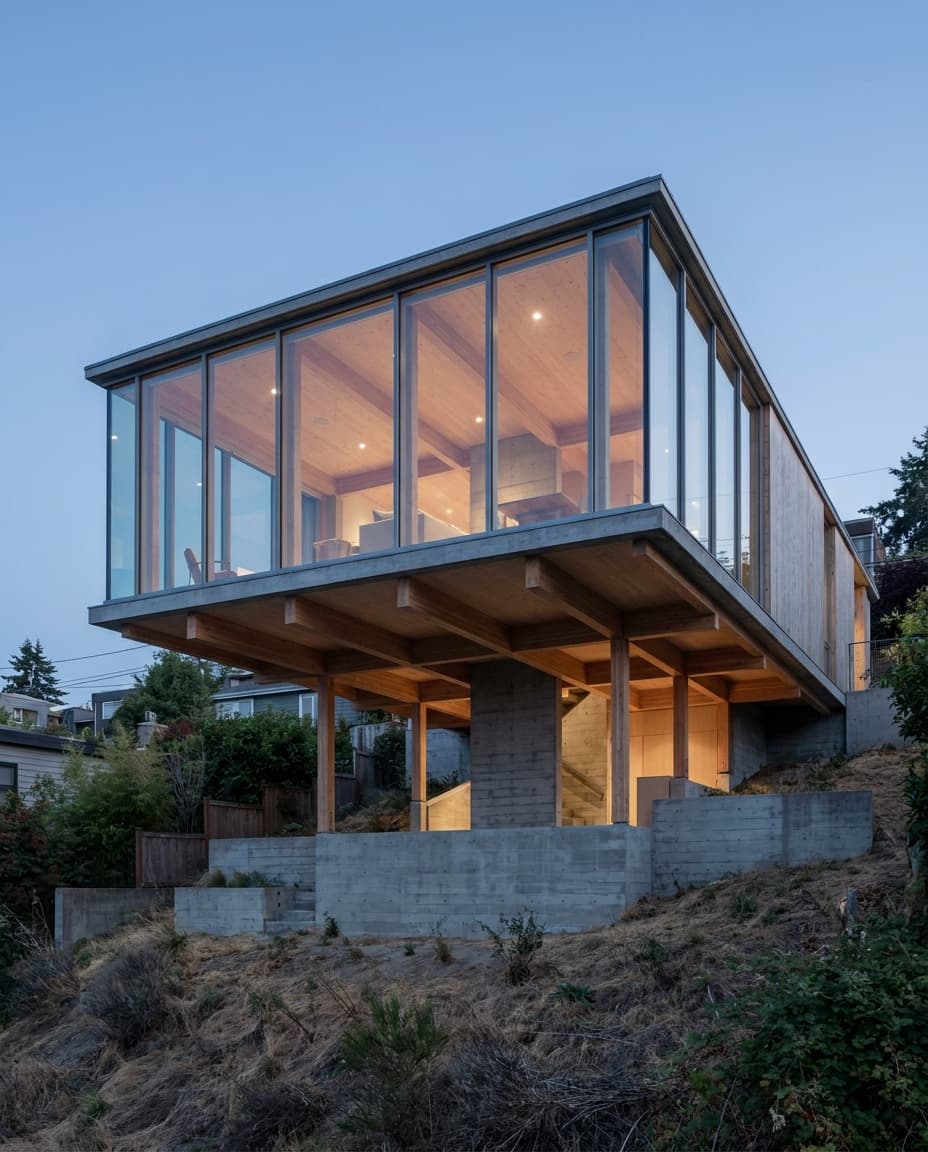
Primary architectural photograph of The Cantilever in Capitol Hill, Seattle, no people in frame

Demo only; the full gallery is shown for the marquee listing. A production marketplace would carry a per-listing gallery.

Contemporary · Capitol Hill, Seattle

The Cantilever

R. Vivero2019

Cross-laminated timber, concrete, glass · Completed 2021

$5,120,000

2,980 sq ft

Materials

Cross-laminated timber primary structure, board-formed concrete foundations and stair core, full-height glazing on the cantilever side. The CLT is exposed throughout the principal interior.

Siting

Steep east-facing lot. The principal living space cantilevers thirty-two feet beyond the foundation line. The cantilever carries the principal view.

Light

First light is the architectural moment; the cantilever's principal glazing faces east.

Provenance

Designed 2019, completed 2021. Single owner since completion. The practice's documentation includes the construction sequence.

Floor plan

Floor plan not on file.

Inquire about The Cantilever.

Inquiries are answered by the practice. Private viewings are arranged through a single point of contact.

Demo only; no message is sent

Datum is a fictitious brokerage built as a RampStack showcase demo. All credited architects and all listings are demo-fictitious; Datum does not exist as a real brokerage, the architects do not exist as real designers, and the homes do not exist outside this demo. No inquiries are sent and no viewings are scheduled.

Arrange a viewing

Private viewings of every listed home are arranged through the practice.

Demo only; no viewing is scheduled and no message is sent

The practice

Datum represents architecturally significant residential homes. Each listing is documented as a small monograph. We do not surface estimated values, comparable-sales overlays, or financing partnerships.

Typography

Cormorant Garamond, Crimson Pro, and Inter, all via Google Fonts.

Datum is a fictitious brokerage built as a RampStack showcase demo. All credited architects and all listings are demo-fictitious; Datum does not exist as a real brokerage, the architects do not exist as real designers, and the homes do not exist outside this demo. No inquiries are sent and no viewings are scheduled.

© Datum demo. RampStack showcase. No real brokerage exists.

RampStack

Built by the RampStack trinity

How Datum was built

The four-stage workup behind this inventory listing demo, summarized. Generalized and pattern-level; no named competitors. The full Format A spec and the verification log live in the operated-side run record.

Stage 01

Basano · competitor review

  • The luxe residential brokerage field clusters in two camps that both leave the gallery-restrained design-led position open. The high-volume luxury tier runs personality-led agent funnels with floor-to-ceiling agent photography, financing partnerships surfaced as primary calls to action, and listing detail pages built around the agent's narrative more than the architecture. The mass-market portal tier runs algorithmic listing presentation with price-anxiety scoring and a financing-first conversion path; design-significant homes appear in the inventory but are not given their own surface treatment.
  • The position the field leaves on the table is a brokerage that treats each architecturally significant listing as a small monograph. The architect's name surfaces in the listing card. The year of design and the year of completion surface in the listing card. Materials, siting, and light are first-class fields on the listing detail page rather than secondary descriptors. The buyer reads the listing the way a design reader reads a publication entry: provenance first, then the photography, then the practicalities. The brokerage's voice supports the listing rather than overshadowing it.
  • Structural standouts the field consistently leaves available cluster on the listing detail page and the brokerage's about page. First, the architect and the design-year surfaced at listing-card density rather than as footer-tier metadata. Second, the listing detail page structured as a monograph: photography sequence, the architect-and-materials anatomy, the floor plan as a first-class artifact, the siting and light, the renovation history if any. Third, the brokerage represented as a practice rather than as a roster of individual agents with headshots; the practice speaks in a unified design-literate voice.
  • Voice standouts the field leaves available cluster on restraint. The high-volume luxury tier writes listings as promotional copy with adjective-density driven by sales priorities. A brokerage that writes listings in the architectural-essay register, naming what is there and letting the architecture speak, reads as design-literate without performing it.
  • Honesty signals available to a new entrant cluster on disclosure. The mass-market portals run synthetic-data overlays (estimated value, comparable sales, market trends) without sourcing them clearly. A brokerage that names every data source on every listing, and that explicitly says when a field is not known rather than estimating it, signals editorial discipline at the same level the architectural register expects.

Stage 02

Krine · positioning

Position
Luxe-considered, editorial-restrained residential brokerage of architecturally significant homes. Each listing is documented as a small monograph (Materials, Siting, Light, Provenance, floor plan as first-class artifact). The brokerage represents itself as a practice in a unified design-literate voice rather than as a roster of individual agents. Luxe Considered leads with Editorial Restrained as composition secondary; Documentary Honest and Rugged Utilitarian secondaries considered and rejected; pure luxe-considered rejected as catalog-luxury. Selected via the creative-brief-selector skill under its extended framework; full brief at progress/inventory-listing-datum-brief.md. First same-shape build in the portfolio (inventory-listing, the same shape Treeline Motors shipped).
Archetype
luxe-architectural-brokerage
Voice
Design-literate, architecturally restrained, third-person where the brokerage speaks. Architecture-aware vocabulary at restrained density. The brokerage does not invoke individual-agent personalities; it speaks as a practice. Bylines do not appear on listing copy because no individual agents are surfaced; the architect-and-year credit lockup is the publication's signature credit treatment.
Stage 03

Tholo · build plan

home

  • creative-brief-selector
  • competitor-experience-audit
  • vertical-site-conventions
  • landing-page-copy
  • information-architecture
  • frontend-component-build
  • seo-onpage

listings

  • frontend-component-build
  • information-architecture

listing detail (dynamic)

  • creative-brief-selector
  • frontend-component-build
  • landing-page-copy
  • seo-onpage

the practice

  • landing-page-copy
  • frontend-component-build

architects

  • frontend-component-build
  • landing-page-copy

workup

  • landing-page-copy
  • frontend-component-build

Stage 04

Basano · verification

Holds(14)

  • Heading hierarchy holds across all six pages: exactly one H1 per page, H2 / H3 sequence with no skipped levels.
  • Language declaration, semantic landmark structure (header, main with id=main-content, footer, nav with aria-label), and the skip-navigation link via ShowcaseMetaLayer are all present and correctly wired across the microsite.
  • JSON-LD Organization on the layout with Brand subOrganization for Datum; CreativeWork on the layout. BreadcrumbList on every non-home page. ItemList on home and listings. SingleFamilyResidence schema on every listing detail page with name, locality-scale address (no fabricated street address), floorSize, and Offer with priceSpecification. AboutPage on the practice page. CollectionPage on the architects page.
  • Hero zone carries the asymmetric-large-image-small-text shape per the brief: a single architectural photograph occupies roughly seven of ten columns at desktop; a narrow caption-scale type column carries the eyebrow, the featured listing title, the architect-and-year credit lockup, a short siting note, and two CTAs. The hero is image-dominant and not balanced dual-column.
  • Provenance-led listing cards on home and listings pages: architect-and-year credit lockup with the Patina drawn rule separator (no em-dash or en-dash glyph anywhere), materials micro-label, neighbourhood-and-city locality, Crimson Pro tabular-nums asking price. No transparency band (the same-shape divergence guardrail explicitly excludes Treeline's data-flag band).
  • Monograph listing-detail anatomy on every detail page: photo gallery, architect-and-year credit lockup at display weight, four anatomical fields stacked in named order (Materials, Siting, Light, Provenance), floor plan as a first-class artifact with honest empty state where absent, single inquiry CTA labelled demo-only. No four-history-tables, no comparison rail, no saved search; the same-shape divergence guardrail excludes them.
  • Marquee listing (The Hillside Pavilion in Murray Hill, San Francisco, designed by E. Vasconcellos in 1957) carries the full monograph prose across all four anatomical fields plus a twelve-photograph gallery placeholder set; the other four listings carry the four fields at lighter density and a single primary image plus the demo-only gallery note.
  • Editorial-restrained register held: warm limestone ground (#e8e2d4) with iron (#1f2125) primary type, patina (#5c7a72) as the single primary accent (credit lockup separator, CTA fill, dark CTA band fill), cinder (#3e5854) on hover, sand (#bfae8f) as the quiet warm accent. Cormorant Garamond (400 and 600 with italics loaded explicitly) for display and the italic wordmark; Crimson Pro (400 and 600) for body and tabular-nums numerics; Inter (400 and 500) for chrome and micro-labels. Brand wordmark in Cormorant Garamond 600 italic at tracking-[0.06em] (true italic axis, not synthesized oblique). Micro-labels in Inter uppercase at tracking-[0.18em], weight 500.
  • Footer carries the dark-cta-then-credits shape per the brief: an Iron-grounded dark CTA band on top with Patina-filled Arrange a private viewing CTA and a Sand-coloured demo-only label, a credits strip below with the practice statement, typography credits, the fictitious-brand disclosure, and minimal nav. Footer chrome convention applied: no outer margin, inner padding absorbs the spacing.
  • Architect convention held: eight credited architects in the inventory (E. Vasconcellos, K. Sato, M. Bencic, O. Plaschka, R. Vivero, T. Linder, L. Eskildsen, A. Halpern), surnames vetted against the brief's exclusion list (Neutra, Schindler, Koenig, Lautner, Meier, Ando, Zumthor, Aalto, Kahn, Eames, Saarinen, Mies, Gropius, Le Corbusier, Wright, and others). Architects page surfaces only architects credited on at least one listing; demo-fictitious disclosure at page level repeats on every essay-page foot.
  • Practice convention held: no individual agents, no agent headshots, no agent names anywhere in copy, no agent-specific contact paths. The brokerage speaks as a practice. The Practice page declares what the practice does and what it declines to do.
  • Demo-only labelling on the inquiry CTA and the private-viewing CTA is consistent and visible in the brand's Patina accent.
  • Architectural-monograph photography shipped across the build: 1 hero (4:5 portrait of The Hillside Pavilion in late-afternoon light) plus 1 dedicated landscape thumbnail crop (16:10) of the same Hillside Pavilion for the showcase-index card container, plus 5 listing-card primary photographs (one per listing, each bound to the listing's named era, materials, form, and light note), plus 14 marquee-gallery photographs (all of the same Hillside Pavilion across a considered architectural sequence: exterior three-quarter, profile section, long glazed elevation, principal-living-space interior in late-afternoon bars, stepped-living view, principal-bedroom first-light, lower terrace and fountain, north-lit kitchen, board-formed concrete detail, redwood joinery detail, bay view through glazing, wide environmental, entry approach, interior looking back). All 21 generated through the v2 image pipeline in showcase-demo mode as one consistent architectural-monograph register. The register is the deliberate divergence from Treeline's documentary working-context photography: considered, composed, still, light-aware, unpeopled. No people in any frame. No real brand marks. No fabricated brokerage trade dress. Non-resemblance guardrail held: the Cantilever reads as exposed CLT over board-formed concrete on a dry Seattle urban slope (not Fallingwater); no generated home resembles any recognizable real building.
  • Three schematic floor-plan SVGs built as hand-written line drawings (NOT pipeline-generated): The Hillside Pavilion (sectional showing three terraced levels stepping down the slope with the board-formed concrete spine wall in Patina running across all three), The Ridge House (single low horizontal bar along a south-facing ridge with deep south eave), and The Courtyard Residence (rooms wrapping a central courtyard rendered in board-formed concrete). All three render in the palette (Iron and Sand on Alabaster) with minimal text (north arrow and scale bar only). The two listings without plans (The Cantilever, The Garden House) keep the honest Floor plan not on file empty state.

Fails(5)

  • Intentional noindex and nofollow on the demo build (correct for a demo, flagged by the verifier across pages against a production-ready standard). Same not-a-defect-in-context the prior demos carry.
  • Canonical URL declares the production rampstack.co host while the build is served from localhost during the audit; cross-origin canonical mismatch is the localhost-vs-production artefact, not a real defect. Recurring across all pages.
  • Title tags and H1s on inner pages lean structural (Listings, The Practice, Architects) rather than search-keyword-aligned. Judgment item for the showcase context; a live luxe brokerage would target the architectural era and the city explicitly.
  • Logo-less type lockup; the Cormorant Garamond italic wordmark over limestone is the type-led placeholder this batch ships with. The logo pass is a separate per-brand later dispatch.
  • Non-marquee listing detail pages render a single primary image plus a demo-only note instead of a full gallery; a production marketplace would carry per-listing galleries. Intentional for the demo's photo-density convention.

Not assessable(6)

  • Core Web Vitals and page experience (no field data in a static-fetch audit).
  • robots.txt and XML sitemap content (single-page audit does not crawl).
  • Real listing-data backend integration (none in this build by design; demo inventory is a static module of fictitious listings).
  • Real inquiry and viewing-scheduling backend (intentionally absent; the inquiry CTA and the private-viewing band are demo-only).
  • Real architect or seller verification (intentionally absent; all architect identities are demo-fictitious).
  • Mobile responsiveness past basic reflow at the audit viewport (separate device captures required).