Pickup · 4WD · Automatic · Sawtooth Bend

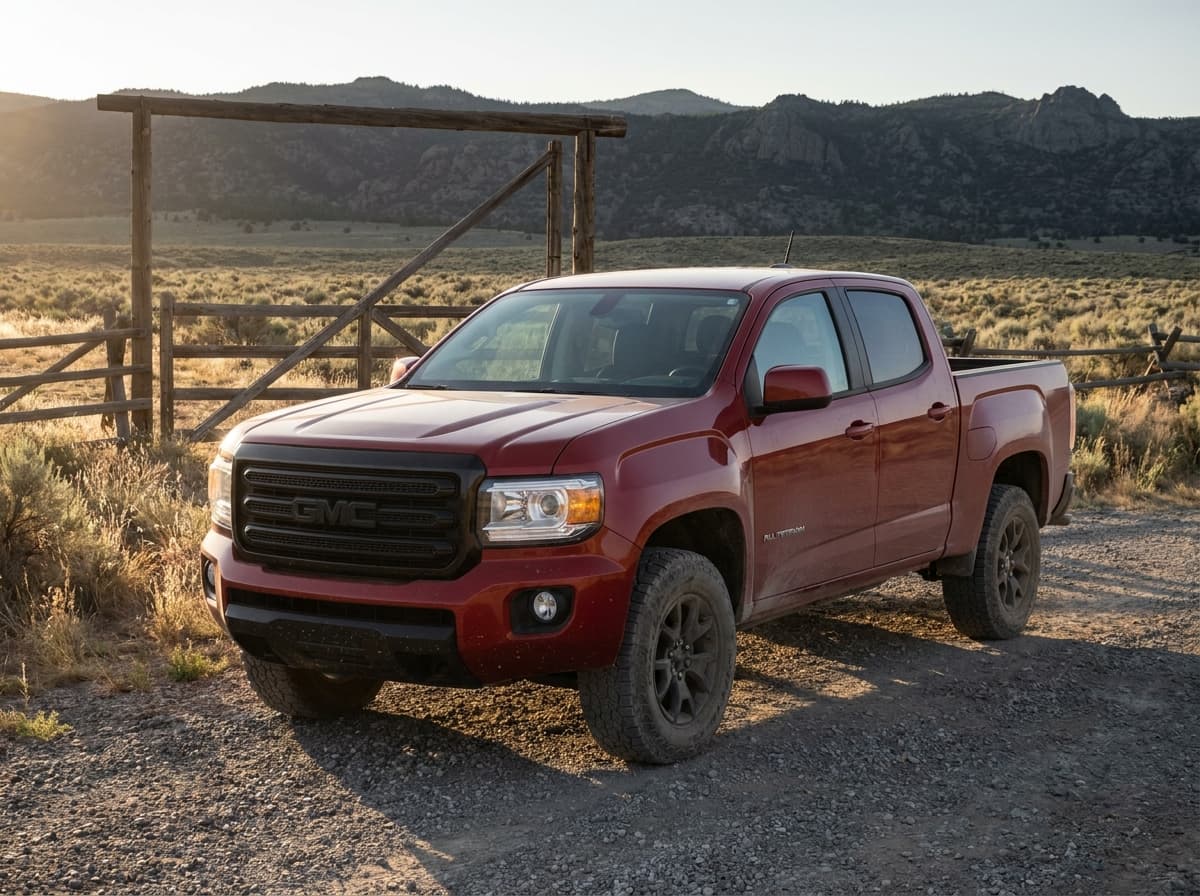
2017 GMC Canyon All Terrain

Crew cab short bed, 3.6L V6, two owners, one minor claim from 2020.

$23,400

89,300 mi

12 photographs on this listing

Primary listing photograph: 2017 GMC Canyon All Terrain in working context, no logos overlaid, no identifiable close portraits

Demo only; this listing has additional photos in the production marketplace. The marquee listing on this demo carries the full twelve-photograph gallery as the photo-density reference.

  • Price
  • Owners
  • Clean
  • Service

Price history

Source: Demo Pricing Records

DateAsking priceNote
2026-03-12$24,900Initial listing
2026-05-01$23,400Price reduced

Ownership history

Source: Demo Title History Service

OwnerRegionTenure
Owner 1Sawtooth Bend52 months
Owner 2Sawtooth Bend45 months

Accident history

Source: Fictitious Claims Reports Inc.

DateSeverity
2020-09-22minor

Mechanical history

Source: Demo Service Network

DateMileageService
2021-12-0853,400 miOil, brakes, rotation

Seller

Private seller

Sawtooth Bend, Mountain West

All seller identities on Treeline are demo placeholders. No real party owns this fictitious vehicle.

Demo only; no message is sent

Treeline Motors is a fictitious specialty marketplace built as a RampStack showcase demo. Mountain West regions are real geographic terms; specific dealers and listings are demo placeholders. No inquiries are sent and no listings are real.

RampStack

Built by the RampStack trinity

How Treeline Motors was built

The four-stage workup behind this inventory listing demo, summarized. Generalized and pattern-level; no named competitors. The full Format A spec and the verification log live in the operated-side run record.

Stage 01

Basano · competitor review

  • Used-vehicle marketplace homepages cluster in two tiers and leave the regional working-vehicle specialist tier wide open. The mass-market national tier runs price-anxiety scoring as the hero move, financing-first conversion architecture, and a passenger-car-dominant inventory mix. The DTC mass-market tier runs vending-machine theatrics over national fulfilment with financing-first conversion. Neither tier serves a buyer in the Mountain West shopping for a vehicle they will actually use for terrain.
  • Listing-detail transparency is solved in the auction-collectible tier and unsolved in the fixed-price marketplace tier. The canonical auction marketplaces surface full ownership history, mileage timelines, dense photograph counts, and provenance threads as load-bearing elements of the listing-detail page. The fixed-price marketplace field treats the same data as ancillary, behind a click, or absent. The transparency anatomy transfers cleanly to a fixed-price marketplace without the auction mechanics.
  • Working-vehicle photography is rare across the field. The mass-market field leans on dealer-lot studio shots: vehicle in front of a building, three-quarter front, brand-neutral background. A regional specialist photographed in the working context (truck on a gravel forest road, four-wheel-drive SUV on a snowed-in switchback, utility vehicle at a job site) signals what the marketplace is for without copy lifting any weight.
  • Voice and palette consistency is uniform across the mass-market field: flat blue-and-white palettes, neutral national voice. A regional specialist with a Mountain West palette (cool granite ground with restrained evergreen and oxblood accents) and a plain-direct voice that speaks with familiarity of terrain reads as the kind of marketplace its audience actually wants without leaning on regional cliches.
  • Trust signals are inconsistently surfaced across the field. Data-source attribution, regional inspection-partner referrals, pre-purchase inspection guarantees, and contracts policy are surfaced inconsistently and usually as footer-tier content. Surfacing them as a discrete trust strip near the inventory teaser is the structural standout the audited field leaves available.

Stage 02

Krine · positioning

Position
Rugged-utilitarian, documentary-honest regional Mountain West marketplace for used working vehicles. Transparency-first on every listing (price, ownership, accident, mechanical history surfaced with source attribution). Filter-rail inventory grid with the four-data transparency band per card; listing-detail page anatomy stacks the four history tables; comparison rail supports three vehicles side by side; saved search persists in browser storage. Rugged Utilitarian leads with Documentary Honest as composition secondary; selected via the creative-brief-selector skill; full brief at progress/inventory-listing-treeline-motors-brief.md.
Archetype
rugged-utility-marketplace
Voice
Plain-direct and specifics-first. Named vehicle categories, named regions, named third-party providers (with the Demo or Fictitious prefix), named partner shops. No marketing inflation. No best, leading, or premier. The marketplace speaks the way a competent independent shop would speak.

Stage 03

Tholo · build plan

home

  • creative-brief-selector
  • competitor-experience-audit
  • vertical-site-conventions
  • landing-page-copy
  • information-architecture
  • frontend-component-build
  • seo-onpage

inventory (search results)

  • frontend-component-build
  • information-architecture
  • landing-page-copy

listing detail (dynamic)

  • creative-brief-selector
  • frontend-component-build
  • landing-page-copy
  • seo-onpage

workup

  • landing-page-copy
  • frontend-component-build

Stage 04

Basano · verification

Holds(11)

  • Heading hierarchy holds across all four pages: exactly one H1 per page, H2 / H3 sequence with no skipped levels.
  • Language declaration, semantic landmark structure (header, main with id=main-content, footer, nav with aria-label), and the skip-navigation link via ShowcaseMetaLayer are all present and correctly wired across the microsite.
  • JSON-LD Organization on the layout (with Brand subOrganization for Treeline Motors); BreadcrumbList on every non-home page; ItemList on the inventory index; Vehicle schema with mileageFromOdometer, vehicleTransmission, driveWheelConfiguration, plus an Offer with priceSpecification on every listing detail page.
  • Hero zone carries the load-bearing inventory-listing conventions: a wide working-context hero photograph at the top of the page (full-width within the content container, aspect 21:9 on desktop), H1 plus lede stacked beneath the photograph, and a full-width search rail below the lede carrying vehicle-type chips, drive chips, transmission chips, year range, price range, and a Mountain West region selector. The primary CTA Browse the inventory and the secondary Save a search anchor under the search rail.
  • Inventory grid card carries the four-icon transparency band below the photograph; the band signals at a glance whether the listing has full price history, full ownership history, no accidents, and full mechanical records.
  • Listing detail page renders the four history tables stacked in named order (price, ownership, accident, mechanical), each followed by a one-line source attribution naming the demo-only third-party provider.
  • Empty mechanical-history tables surface as No records submitted in context rather than being hidden; the empty state is part of the design.
  • Working client-side comparison rail (max 3 vehicles, persists in localStorage) and saved search (filter combination persists in localStorage with a demo-only labelled opt-in). No payment, no real backend.
  • Rugged-utilitarian register held: cool granite ground (#f4f5f7 page, #2a2d31 dark sections) with evergreen #1f4d3a as the positive-signal accent, oxblood #7a1f2b as the primary CTA, aspen gold #c4a456 as a layered warm accent. Source Serif 4 400 / 600 for display, IBM Plex Sans 400 / 500 for body, IBM Plex Mono 400 for every numeric in the four history tables. Brand wordmark in serif UPPERCASE at tracking-[0.04em]; micro-labels in sans UPPERCASE at tracking-[0.08em]. Distinct from Pinto Mesa Boots' sans uppercase at the same wordmark tracking (the differentiator is the family) and from Northbound's serif small-caps at tracking-[0.06em] (the differentiator is the casing model).
  • Demo-only labelling on the inquiry form, the saved-search opt-in, and the comparison-rail persistence note is consistent and visible in the brand's oxblood CTA colour.
  • Documentary editorial photography shipped across all four pages, anchored to each listing's named year, make, model, trim, and body color: a wide working-context home hero, three generic-per-category strip photographs (pickup, four-wheel-drive SUV, utility), 15 inventory-card photographs that each match the corresponding listing's vehicle data (a 2019 Ford F-250 Super Duty Lariat listing is photographed as a 2019 Ford F-250 Super Duty Lariat in Magnetic Grey; a 2017 Toyota Tacoma TRD Off-Road as a 2017 Tacoma TRD Off-Road in Inferno Orange; a 2016 Jeep Wrangler Unlimited Rubicon as a 2016 Wrangler Unlimited Rubicon in black; and so on for each of the 15), 12 marquee-listing gallery photographs all depicting the same specific 2019 Ford F-250 Super Duty Lariat in Magnetic Grey from 12 angles (exterior three-quarters, profile, Lariat-spec dashboard with Sync 3 infotainment and heated leather seating, rear bench, instrument cluster reading 68,412 miles, 6.7L Power Stroke diesel engine bay, factory eighteen-inch alloy wheel with Continental TerrainContact tyres, cargo bed, wide environmental, honest-wear detail, trailhead environmental), one Mountain West treeline-and-granite-ridge atmospheric ground behind the inquiry CTA close, and one granite-textured inventory banner. All 33 photographs generated through the v2 image pipeline in showcase-demo mode as one consistent documentary shoot: Filson and Patagonia field register, warm directional natural light, Mountain West landscape (alpine, sub-alpine, sagebrush, granite ridges) without identifiable national park names or landmarks. Honesty constraints held per the brief: no fabricated identifiable portraits anywhere in the set (where any person appears at all they are environmental, faces away or out of frame), real-brand badging on the depicted real-brand vehicles renders naturally as documentary register (visible Ford emblem on the F-250 grille, Jeep grille on the Wrangler, etc. all permitted because the listings are for those real-brand vehicles), no fabricated brand marks (no Treeline stickers on any vehicle, no invented dealer decals), no fabricated owner identities, no imitation of CarGurus, Carvana, Bring a Trailer, AutoTempest, Edmunds, Cars.com, or Hagerty layout or trade dress in the photographs themselves.

Fails(5)

  • Intentional noindex and nofollow on the demo build (correct for a demo, flagged by the verifier across pages against a production-ready standard). Same not-a-defect-in-context the prior demos carry.
  • Canonical URL declares the production rampstack.co host while the build is served from localhost during the audit; cross-origin canonical mismatch is the localhost-vs-production artefact, not a real defect. Recurring across all pages.
  • Title tags and H1s on inner pages lean structural (Inventory, Workup) rather than search-keyword-aligned. Judgment item for the showcase context; a live regional marketplace would target topical keywords explicitly.
  • Logo-less type lockup; the Source Serif 4 uppercase wordmark over snowline is the type-led placeholder this batch ships with. The logo pass is a separate per-brand later dispatch.
  • Non-marquee listing detail pages render the listing's primary card image plus a demo-only note instead of a full gallery; the marquee listing carries the full twelve-photograph gallery as the photo-density reference. Production marketplace listings would carry seller-supplied galleries per listing.

Not assessable(6)

  • Core Web Vitals and page experience (no field data in a static-fetch audit).
  • robots.txt and XML sitemap content (single-page audit does not crawl).
  • Real inventory-data backend integration (none in this build by design; demo inventory is a static module of fictitious listings).
  • Real third-party-provider data feeds (intentionally absent; source-provider names on listing-detail tables are demo placeholders).
  • Real seller-vetting workflows (intentionally absent; the inquiry CTA is demo-only).
  • Mobile responsiveness past basic reflow at the audit viewport (separate device captures required).